
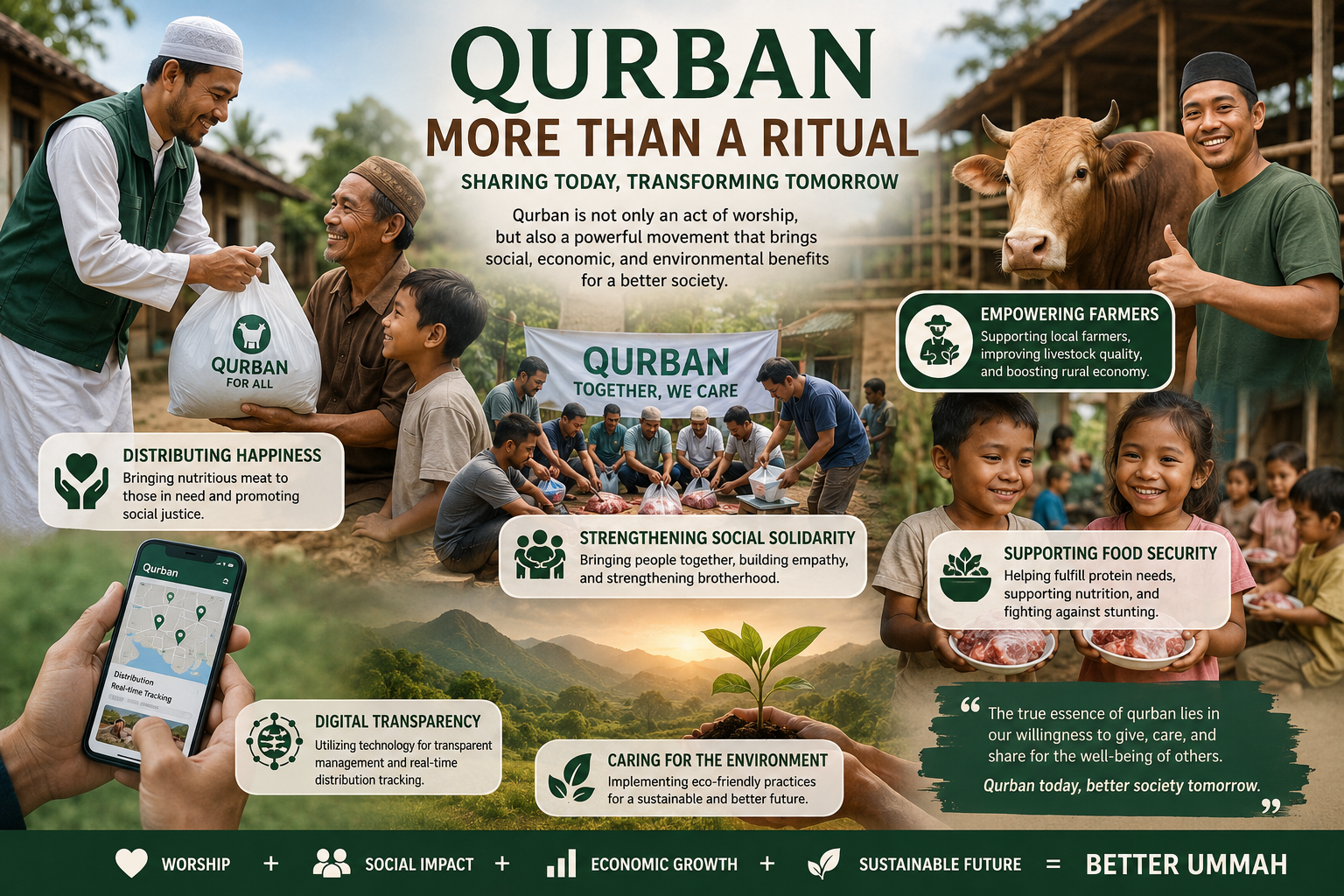
Eid al-Adha has long been associated with the slaughtering of sacrificial animals and the distribution of meat to communities. However, behind this annual tradition lies a much greater social power. In the modern era, qurban is no longer understood merely as an individual act of worship, but has evolved into an instrument of social empowerment, a driver of grassroots economic growth, and a force that strengthens social solidarity.
This phenomenon makes qurban increasingly relevant to discuss in today’s society. Many scholars now view qurban as part of a social development strategy rooted in Islamic values.
Qurban and Social Transformation Amid Economic Inequality
In the midst of growing economic disparities, qurban serves as a real form of wealth redistribution. During Eid al-Adha, financially capable Muslims share with communities that rarely have access to nutritious animal protein.
For many underprivileged families, qurban meat may become one of the best sources of nutrition they receive throughout the year. In this context, qurban is not only a symbol of Prophet Ibrahim’s sacrifice, but also a practical manifestation of social justice.
One of the most significant modern developments in qurban practices is the shift in mindset from “simply distributing meat” to “creating sustainable social impact.” Today, many institutions have introduced innovative concepts such as:
• community empowerment-based qurban,
• rural and remote-area qurban,
• food security-oriented qurban,
• and environmentally friendly qurban programs.
These approaches ensure that the impact of qurban extends beyond the day of slaughter and becomes part of a long-term social movement.
From Consumptive Tradition to Productive Empowerment
For decades, qurban was often viewed as a purely consumptive annual activity. However, the idea of “Productive Qurban” has recently emerged, focusing on empowering local livestock farmers long before Eid al-Adha arrives.
This model includes:
• mentoring small-scale farmers,
• improving livestock health management,
• providing access to Islamic financing,
• and purchasing animals directly from assisted farmers.
Through this approach, qurban creates a healthier economic cycle for rural communities.
From the perspective of Islamic economics, qurban generates a significant multiplier effect because it stimulates various sectors, including:
• local livestock farming,
• animal trading,
• logistics and transportation,
• food processing industries,
• and small and medium enterprises (SMEs).
This means that a single sacrificial cow represents not only an act of worship, but also an economic catalyst for lower-income communities.
Qurban and the Strengthening of Social Solidarity
In today’s increasingly individualistic world, qurban creates a valuable space for social interaction and cooperation. Communities gather together, work collectively, and support one another during the slaughtering and meat distribution process.
These activities help foster:
• social awareness,
• empathy,
• mutual cooperation,
• and stronger bonds among community members.
Research on the social value of qurban indicates that the distribution of sacrificial meat helps strengthen relationships and reduce social gaps between wealthy and underprivileged groups.
In many regions of Indonesia, qurban moments even become opportunities for social reconciliation. People who rarely interact throughout the year can come together and collaborate regardless of their social or economic backgrounds.
The Digital Era Is Reshaping Qurban
Technological development has also transformed the face of qurban in the digital age. Today, Muslims can perform qurban online through trusted digital platforms and charitable organizations.
This transformation has introduced innovations such as:
• real-time tracking of qurban distribution,
• transparent fund management,
• distribution to remote regions,
• and cross-regional qurban programs.
Digital systems make qurban distribution more effective, transparent, and equitable. Some initiatives now specifically target areas with limited access to meat consumption, regions affected by stunting, and disaster-affected communities.
These innovations demonstrate that qurban can adapt to modern developments without losing its spiritual essence.
Qurban and Community Food Security
One aspect that is rarely discussed is qurban’s contribution to food security. The large-scale distribution of qurban meat helps fulfill the protein needs of low-income communities.
In a country like Indonesia, where issues such as child stunting and malnutrition still exist, qurban holds tremendous potential as a social movement centered on nutritious food distribution.
As a result, new ideas have emerged proposing that qurban management should not remain seasonal, but should also be integrated with:
• food empowerment programs,
• public nutrition education,
• and sustainable livestock development.
This is where qurban becomes more than an annual religious ritual. It evolves into a tool for social and economic development.
Building Civilization Through Qurban
The greatest essence of qurban lies in humanity’s willingness to share and reduce social selfishness. When individuals willingly sacrifice part of their wealth for the benefit of others, human values flourish.
Qurban teaches that prosperity should not stop at personal satisfaction. The spirit of sharing must become a driving force for building a more just, caring, and empowered society.
If managed professionally and innovatively, qurban can serve as:
• a tool for empowering the Muslim economy,
• a pillar of social solidarity,
• an instrument for equitable welfare distribution,
• and a humanitarian solution rooted in religious values.
Therefore, Eid al-Adha should not only be understood as a ritual of animal sacrifice, but also as a momentum for building a more compassionate and humane civilization.