
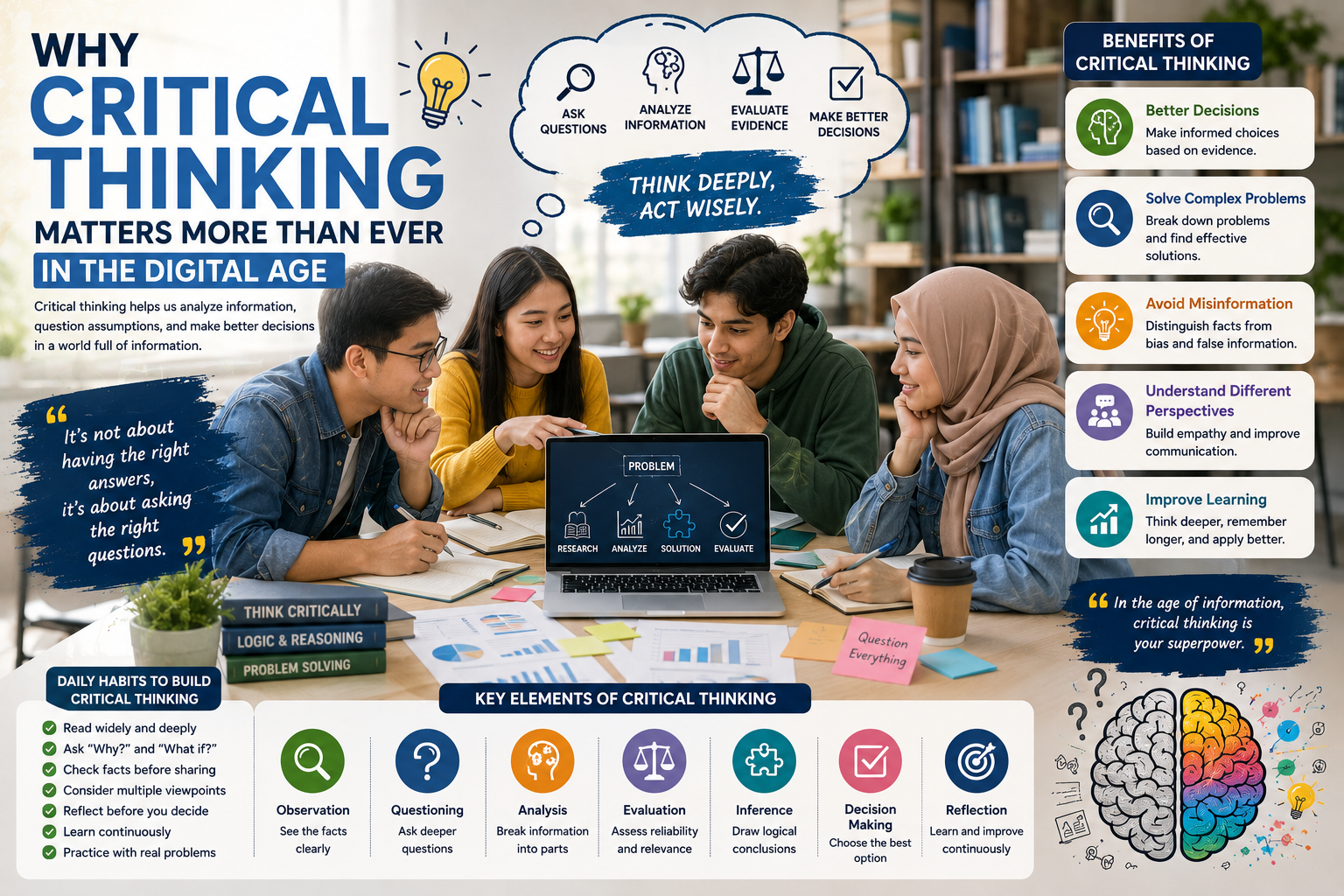
Every day, people are exposed to an overwhelming amount of information. News articles, social media posts, videos, podcasts, and artificial intelligence tools provide answers almost instantly. While access to information has never been easier, distinguishing facts from opinions, reliable sources from misinformation, and meaningful insights from noise has become increasingly difficult.
This is why critical thinking has become one of the most valuable skills in the 21st century. It is no longer enough to simply consume information. Individuals need the ability to question, analyze, evaluate, and make informed decisions based on evidence.
Whether you are a student, educator, entrepreneur, or professional, critical thinking helps you navigate complexity, solve problems, and adapt to a rapidly changing world.
What Is Critical Thinking?
Critical thinking is the ability to analyze information objectively before forming a conclusion or making a decision.
Rather than accepting ideas at face value, critical thinkers ask questions, examine evidence, identify assumptions, and consider multiple perspectives.
It is a skill that combines logic, curiosity, reflection, and open-mindedness.
Critical thinking is not about criticizing others. Instead, it is about thinking carefully and making reasoned judgments.
Why Is Critical Thinking Important Today?
Technology has transformed how people learn and communicate.
Search engines and AI-powered tools can provide answers within seconds, but they cannot replace human judgment.
People still need to decide whether information is accurate, ethical, and relevant.
Without critical thinking, it becomes easier to believe misinformation, fall for scams, or make poor decisions based on incomplete facts.
Critical Thinking in Education
Schools and universities are increasingly focusing on developing critical thinking rather than memorization.
Students are encouraged to:
• ask meaningful questions;
• analyze real-world problems;
• work collaboratively;
• evaluate different viewpoints;
• apply knowledge in practical situations.
This approach prepares learners for challenges beyond the classroom.
Critical Thinking in the Workplace
Employers value professionals who can solve problems independently.
Instead of waiting for instructions, critical thinkers identify issues, explore possible solutions, and make informed recommendations.
These abilities are particularly valuable in leadership, project management, marketing, technology, healthcare, and entrepreneurship.
As automation continues to grow, human reasoning becomes even more important.
The Connection Between Critical Thinking and Artificial Intelligence
Artificial Intelligence (AI) can generate text, summarize information, and analyze large amounts of data.
However, AI should be viewed as a tool rather than a replacement for human thinking.
Users must still verify information, recognize potential biases, and make ethical decisions.
Critical thinking allows people to use AI responsibly and effectively.
How to Develop Critical Thinking Skills
Like any other skill, critical thinking improves through practice.
Here are several habits that can help:
• Read from multiple reliable sources.
• Ask “Why?” and “How?” more often.
• Verify information before sharing it.
• Listen to different perspectives.
• Reflect before making decisions.
• Practice solving real-world problems.
• Stay curious and continue learning.
Small daily habits can gradually strengthen analytical thinking.
Common Barriers to Critical Thinking
Several factors may prevent people from thinking critically.
These include:
• confirmation bias;
• emotional decision-making;
• information overload;
• lack of reliable sources;
• pressure to respond quickly.
Being aware of these challenges is the first step toward overcoming them.
Critical Thinking as a Lifelong Skill
Learning does not end after graduation.
Professionals who continue asking questions, exploring new ideas, and evaluating information carefully remain more adaptable throughout their careers.
Critical thinking supports lifelong learning because it encourages continuous curiosity and improvement.
Conclusion
In today’s digital world, information is abundant, but wisdom requires thoughtful analysis.
Critical thinking empowers individuals to evaluate evidence, make better decisions, solve complex problems, and use technology responsibly.
As the world continues to evolve, critical thinking will remain one of the most valuable skills for education, work, and everyday life.
Developing this skill is not about knowing every answer—it is about asking better questions.
Frequently Asked Questions
What are critical thinking skills?
Critical thinking skills are the abilities to analyze information, evaluate evidence, question assumptions, and make logical decisions.
Why is critical thinking important?
It helps people solve problems, avoid misinformation, make better decisions, and adapt to rapid technological change.
Can critical thinking be learned?
Yes. Critical thinking develops through practice, reading, asking questions, analyzing information, and reflecting on different perspectives.