
Introduction
In a world driven by rapid technological advancements, artificial intelligence, and constant innovation, people are always searching for the best investments to secure their future. Some invest in property, businesses, stocks, or valuable assets. While these investments can generate financial returns, there is one investment that surpasses them all in value and longevity: knowledge.
Unlike material wealth, knowledge cannot be stolen, lost, or diminished when shared. It continues to grow, benefits its owner throughout life, and leaves a lasting impact on future generations. For this reason, knowledge is often regarded as the greatest investment a person can make for success in both this world and the Hereafter.
Why Knowledge Is the Most Valuable Investment
Most investments aim to produce future benefits. Knowledge does the same, but with far greater advantages. It improves decision-making, increases opportunities, enhances personal development, and empowers individuals to contribute positively to society.
Financial investments may fluctuate with economic conditions, but knowledge remains valuable regardless of circumstances. Even when wealth is lost, the knowledge and skills a person possesses can help rebuild success.
History provides countless examples of individuals who transformed their lives through education and continuous learning. Their achievements demonstrate that knowledge is not merely an academic pursuit; it is a powerful tool for personal and societal advancement.
The Changing Nature of Success in the Modern Era
The modern world has entered what many experts call the “knowledge economy.” In this era, information, skills, creativity, and innovation are among the most valuable resources.
Many traditional jobs are being transformed by automation and artificial intelligence. New professions emerge every year, requiring people to learn new competencies and adapt to changing demands. As a result, lifelong learning has become essential.
Today, success is no longer determined solely by physical resources or inherited wealth. Instead, it increasingly depends on a person’s ability to acquire knowledge, develop skills, and continuously adapt to new challenges.
Those who invest in learning are more likely to remain relevant and competitive in an ever-changing environment.
Knowledge in the Perspective of Islam
Islam places extraordinary importance on knowledge and education. The first revelation received by Prophet Muhammad ﷺ emphasized the act of reading and learning.
Allah says in the Holy Qur’an:
“Read in the name of your Lord who created.”
(Qur’an 96:1)
This verse highlights that learning is the foundation of human development and civilization.
Furthermore, Allah promises honor and elevation for those who possess knowledge:
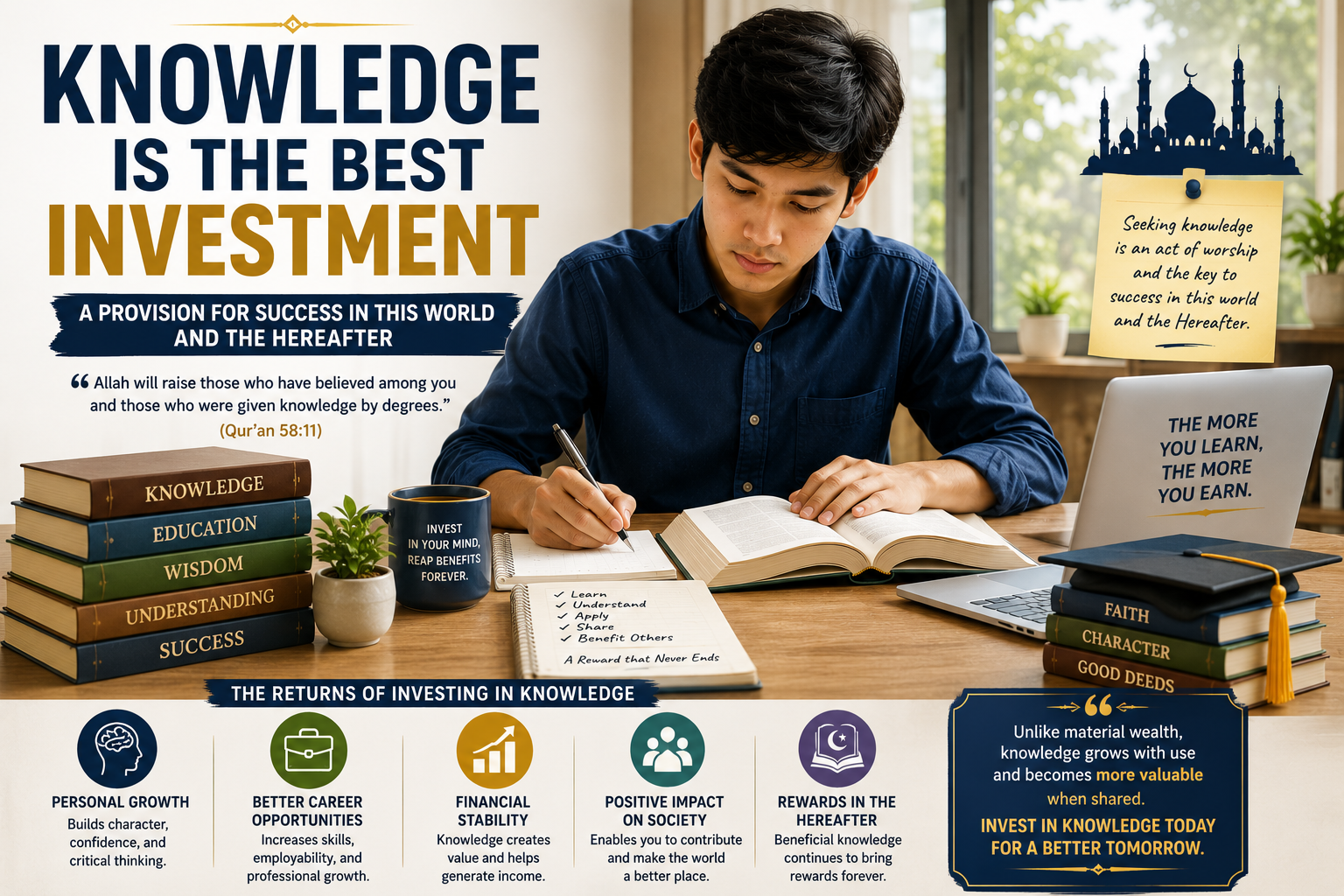
“Allah will raise those who have believed among you and those who were given knowledge by degrees.”
(Qur’an 58:11)
These teachings demonstrate that knowledge is not only a means of achieving worldly success but also a path to spiritual growth and divine reward.
The Prophet Muhammad ﷺ also said:
“Whoever follows a path in pursuit of knowledge, Allah will make easy for him a path to Paradise.”
(Sahih Muslim)
This hadith clearly illustrates the profound significance of seeking knowledge in Islam.
The Returns of Investing in Knowledge
- Personal Growth and Self-Development
Knowledge broadens perspectives and helps individuals understand themselves and the world around them. It develops critical thinking, emotional intelligence, and problem-solving abilities.
A knowledgeable person is better equipped to face challenges and make wise decisions in both personal and professional life. - Better Career Opportunities
Education and skills remain among the most important factors in career advancement. Employers consistently seek individuals who demonstrate competence, adaptability, and a willingness to learn.
Investing in knowledge increases employability and opens doors to leadership positions, entrepreneurship, and innovation. - Financial Stability
While knowledge itself is not money, it often becomes the foundation for financial success. Skills, expertise, and professional competence enable individuals to create value and generate income.
Many successful entrepreneurs and professionals attribute their achievements to continuous learning and self-improvement. - Positive Impact on Society
Knowledge enables people to contribute meaningfully to their communities. Teachers educate future generations, healthcare professionals improve public health, and innovators create solutions to societal problems.
The benefits of knowledge extend far beyond the individual and often influence entire communities and nations. - Rewards in the Hereafter
For believers, knowledge holds a unique spiritual dimension. Learning and teaching beneficial knowledge are considered acts of worship that continue to generate rewards even after a person’s death.
The Prophet Muhammad ﷺ said that when a person dies, their deeds come to an end except for three things, including beneficial knowledge that continues to benefit others.
This makes knowledge an investment with eternal returns.
A New Challenge: Information Abundance Without Understanding
One of the greatest paradoxes of the digital age is that access to information has never been easier, yet genuine understanding remains a challenge.
Millions of articles, videos, and social media posts are available every day. However, consuming information is not the same as gaining knowledge.
Many people spend hours scrolling through content without developing deeper understanding or practical skills. The real challenge today is transforming information into wisdom and action.
This is why intentional learning, critical thinking, and continuous self-education are more important than ever before.
How to Invest in Knowledge Effectively
Investing in knowledge does not always require formal education. Individuals can develop themselves through various methods, including:
• Reading books regularly.
• Attending seminars and workshops.
• Taking online courses.
• Listening to educational podcasts.
• Learning from mentors and experts.
• Engaging in meaningful discussions.
• Applying acquired knowledge in real-life situations.
The key is consistency. Small learning habits practiced daily can produce remarkable results over time.
Conclusion
Knowledge is truly the best investment because it benefits individuals throughout their lives and continues to provide rewards beyond this world. It enhances personal growth, creates opportunities, strengthens faith, and enables meaningful contributions to society.
In an era defined by rapid change and technological advancement, investing in knowledge is no longer optional—it is essential. Unlike material assets that may lose value, knowledge grows with use and becomes more powerful when shared.
Those who dedicate themselves to learning are not only preparing for success in this world but also building a legacy that can benefit others and earn rewards in the Hereafter.
The greatest investment is not what you place in a bank account, but what you place in your mind and heart through knowledge.