
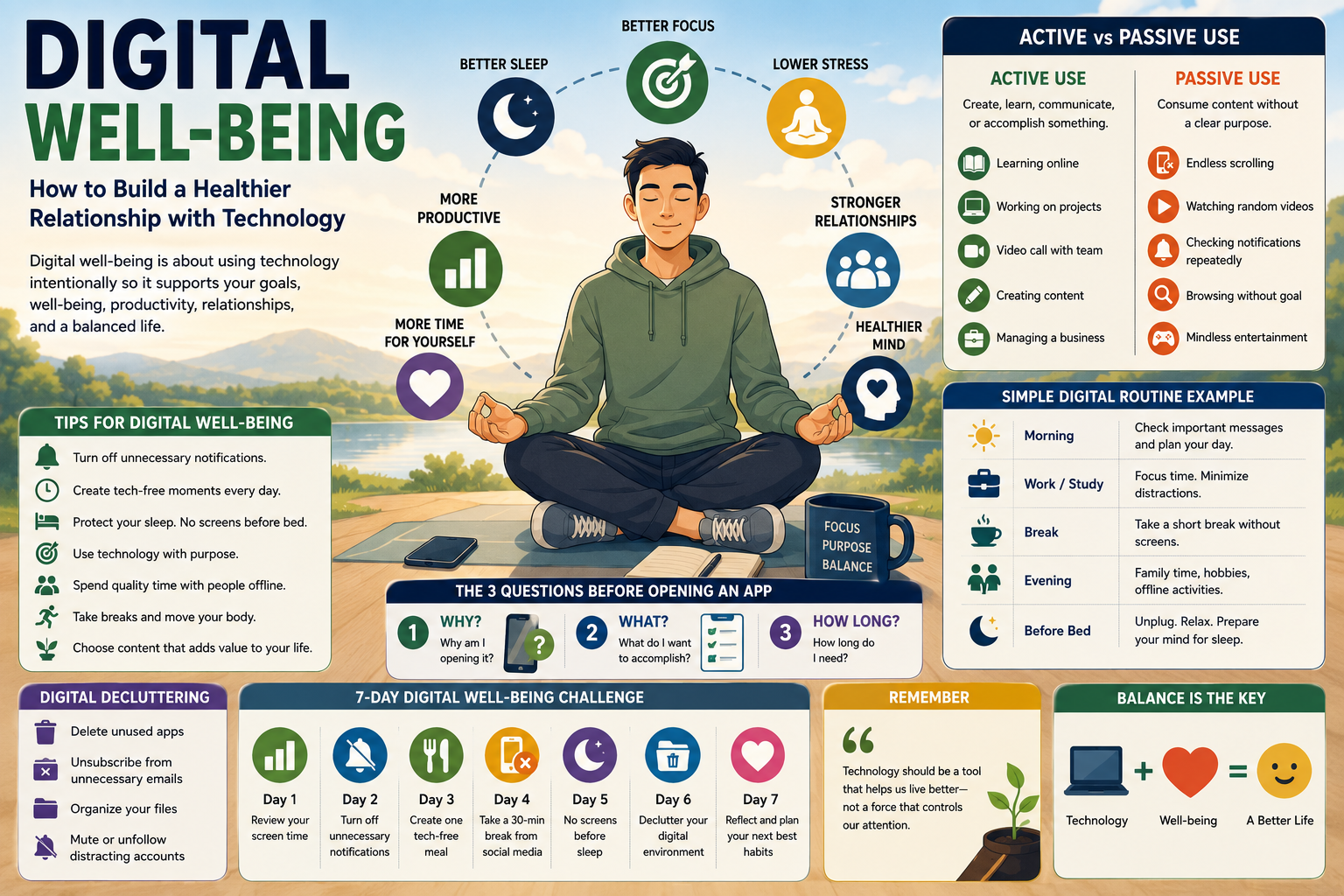
Technology has transformed the way people work, learn, communicate, shop, and entertain themselves. Smartphones, social media, streaming platforms, online meetings, and digital applications have become part of everyday life.
Technology provides enormous benefits, but constant connectivity can also create new challenges.
People may spend hours scrolling through social media, checking notifications, switching between applications, or consuming digital content without realizing how much time has passed.
This is where digital well-being becomes important.
Digital well-being is not about rejecting technology. It is about developing a healthier and more intentional relationship with digital devices and services.
What Is Digital Well-Being?
Digital well-being refers to the healthy and balanced use of digital technology in ways that support a person’s physical, mental, social, and productive life.
It involves asking an important question:
Is technology helping me live better, or am I simply spending more time using it?
The answer may be different for each person.
Using a smartphone for online learning can be productive.
Using the same smartphone for hours of endless scrolling may not provide the same value.
Digital well-being is therefore about intentional use, rather than simply reducing screen time.
Why Does Digital Well-Being Matter?
Digital devices are designed to make information and communication easily accessible.
However, constant notifications and endless content can make it difficult to disconnect.
Digital overload may affect:
• concentration;
• productivity;
• sleep routines;
• face-to-face communication;
• study habits;
• work-life boundaries.
Developing healthier digital habits can help people use technology without allowing it to dominate every part of daily life.
Technology Is Not the Problem
It is easy to blame technology when people experience digital overload.
However, technology itself is not necessarily the problem.
The same device can be used for completely different purposes.
A laptop can be used to:
• complete an important project;
• attend an online class;
• build a business;
• learn a new skill.
It can also be used for hours of unproductive browsing.
The key issue is often how technology is used.
The Difference Between Active and Passive Technology Use
One useful way to understand digital well-being is to distinguish between active and passive use.
Active Use
Active use involves creating, learning, communicating, or accomplishing something.
Examples include:
• writing an article;
• studying;
• designing;
• attending an online course;
• communicating with clients;
• managing a business.
Passive Use
Passive use often involves consuming content without a clear purpose.
Examples include:
• endless scrolling;
• repeatedly checking notifications;
• watching random videos;
• browsing without a specific goal.
Passive use is not always bad, but excessive passive consumption can consume significant amounts of time.
The Notification Problem
Notifications are designed to attract attention.
A single notification may seem harmless.
But repeated interruptions can make it difficult to maintain concentration.
Imagine working on an important task and receiving notifications every few minutes.
Your attention shifts from the task to the phone.
Even after checking the notification, returning to deep concentration may take time.
For this reason, managing notifications is one of the simplest ways to improve digital well-being.
Turn Off Unnecessary Notifications
Not every application needs permission to interrupt you.
Consider disabling notifications from applications that are not essential.
You can keep important notifications such as:
• calls;
• work communication;
• calendar reminders;
• critical messages.
Other notifications can be checked manually at a convenient time.
This simple adjustment can reduce unnecessary interruptions.
Create Technology-Free Moments
Digital well-being does not require eliminating technology completely.
Instead, create specific moments when devices are put aside.
For example:
• during meals;
• during family conversations;
• before sleeping;
• during important meetings;
• while studying;
• during personal reflection.
These small periods can help restore attention to the physical environment and people around you.
Protect Your Sleep
One of the most important areas of digital well-being is sleep.
Many people use smartphones immediately before going to bed.
Notifications, messages, videos, and social media can encourage people to stay awake longer than intended.
Creating a consistent bedtime routine can help.
For example:
30–60 minutes before sleep → reduce unnecessary screen use → prepare for bed → relax → sleep.
The specific routine can vary, but the principle is simple: create a transition between digital activity and rest.
Digital Well-Being for Students
Students face unique challenges because digital technology is now deeply connected to education.
A smartphone or laptop may be necessary for:
• research;
• online classes;
• assignments;
• collaboration;
• educational platforms.
However, the same device can also create distractions.
Students can improve digital well-being by:
• studying with a clear objective;
• disabling unnecessary notifications;
• using focused study sessions;
• taking regular breaks;
• separating entertainment time from study time.
Technology should support learning rather than constantly interrupt it.
Digital Well-Being for Professionals
Remote and hybrid work have blurred the boundaries between work and personal life.
Employees may continue checking work messages after working hours.
Over time, this can make people feel as if they are permanently connected to work.
Creating clear digital boundaries can help.
For example:
Work hours → professional communication
Personal time → reduced work notifications
Rest time → genuine disconnection
Healthy boundaries can improve both productivity and recovery.
Digital Well-Being for Entrepreneurs
Entrepreneurs often need to remain connected to customers and business operations.
However, constantly checking sales, messages, social media, and analytics can become exhausting.
Business owners can establish specific times for checking:
• customer messages;
• social media;
• sales data;
• email;
• business dashboards.
This creates a more structured working routine.
Being available all the time does not necessarily mean being more productive.
Social Media and Comparison
Social media can influence how people perceive their own lives.
People usually share selected moments rather than their entire reality.
As a result, someone may compare their everyday life with another person’s carefully selected highlights.
This can create unrealistic expectations.
A healthier approach is to remember:
Social media shows moments, not the complete story.
Use other people’s success as inspiration rather than as a measurement of your personal worth.
Build a More Intentional Digital Routine
Instead of asking:
“How much screen time do I have?”
also ask:
“What am I doing during that screen time?”
Two people may spend four hours using digital devices, but the outcomes can be completely different.
One may spend the time learning, working, and communicating.
Another may spend most of the time consuming content without a clear purpose.
Therefore, quality of digital activity matters as much as quantity.
The 3 Questions Before Opening an App
A simple habit can help reduce unnecessary digital consumption.
Before opening an application, ask:
- Why am I opening it?
Do I have a specific purpose? - What do I want to accomplish?
What result am I expecting? - How long do I need?
Can I complete the activity and leave?
These questions create a small pause between impulse and action.
Use Technology to Improve Digital Well-Being
Ironically, technology itself can help manage technology use.
Many devices provide tools such as:
• screen-time reports;
• focus modes;
• app limits;
• notification controls;
• bedtime settings;
• do-not-disturb modes.
These tools can provide useful information about digital habits.
The goal is not to achieve a perfect number.
The goal is to become more aware of how technology is affecting daily life.
Digital Decluttering
Just as people clean their physical workspace, they can also clean their digital environment.
Consider removing:
• unused applications;
• unnecessary subscriptions;
• irrelevant notifications;
• old files;
• distracting accounts;
• excessive email subscriptions.
A simpler digital environment can make it easier to focus on what actually matters.
The Importance of Offline Activities
A healthy digital lifestyle should include meaningful offline experiences.
These may include:
• exercise;
• reading physical books;
• walking;
• hobbies;
• family activities;
• face-to-face conversations;
• community involvement;
• outdoor activities.
The goal is not to choose between digital and physical life.
A balanced life makes room for both.
Digital Well-Being and Productivity
Productivity is not about being connected every minute.
Constant connectivity can create the illusion of productivity while reducing concentration.
A more effective approach is to create periods of focused work followed by intentional breaks.
For example:
Focus → Complete → Break → Recover → Focus Again
The exact schedule can be adapted to individual needs.
Digital Well-Being and Artificial Intelligence
Artificial Intelligence is making digital tools even more powerful.
AI can help people:
• summarize information;
• automate repetitive tasks;
• organize ideas;
• analyze data;
• support learning;
• improve productivity.
However, AI can also increase digital dependence if people use it without reflection.
The goal should not be to use AI for everything.
Instead, people should ask:
Where can AI save time while preserving human judgment and creativity?
Responsible technology use remains important even as digital tools become more advanced.
A Simple Digital Well-Being Checklist
Try asking yourself these questions:
• Do I check my phone immediately after waking up?
• Do unnecessary notifications interrupt my work?
• Do I use social media without a clear purpose?
• Do I regularly take breaks from screens?
• Do I use devices immediately before sleeping?
• Can I spend time with others without checking my phone?
• Do I have clear boundaries between work and personal time?
• Does my technology use support my goals?
You do not need to change everything at once.
Start with one habit.
A 7-Day Digital Well-Being Challenge
Day 1
Review your screen-time report.
Day 2
Turn off unnecessary notifications.
Day 3
Create one technology-free meal.
Day 4
Take a 30-minute break from social media.
Day 5
Create a device-free period before sleep.
Day 6
Uninstall or mute distracting applications.
Day 7
Reflect on what changed during the week.
Small changes can create significant improvements when practiced consistently.
The Future of Digital Well-Being
As technology becomes more integrated into everyday life, digital well-being will become increasingly important.
People will use:
• smartphones;
• wearables;
• AI assistants;
• smart homes;
• digital workplaces;
• immersive technologies.
The question will no longer be whether technology is part of our lives.
It already is.
The more important question is:
How can we make technology serve human well-being rather than allowing technology to control our attention?
Conclusion
Digital well-being is about building a healthier and more intentional relationship with technology.
It does not require rejecting smartphones, social media, AI, or digital services.
Instead, it encourages people to use technology with purpose.
Turn off unnecessary notifications. Create technology-free moments. Protect your sleep. Set boundaries. Spend meaningful time offline. Use digital tools to support your goals rather than allowing them to consume your attention.
Technology should be a tool that helps us live better—not a force that constantly competes for our attention.
Frequently Asked Questions
What is digital well-being?
Digital well-being is the practice of using technology in a balanced and intentional way that supports productivity, health, relationships, learning, and overall quality of life.
How can I improve my digital well-being?
Start by reducing unnecessary notifications, creating device-free moments, managing screen time, protecting sleep, and using digital tools with a clear purpose.
Does digital well-being mean avoiding social media?
No. Social media can provide communication, education, business, and entertainment benefits. The goal is to use it intentionally rather than excessively.
Is screen time always bad?
No. The purpose and quality of screen use matter. Learning, working, creating, and communicating are different from passive and endless consumption.
Can technology help improve digital well-being?
Yes. Features such as focus modes, notification controls, screen-time reports, and app limits can help people become more aware of and manage their digital habits.