
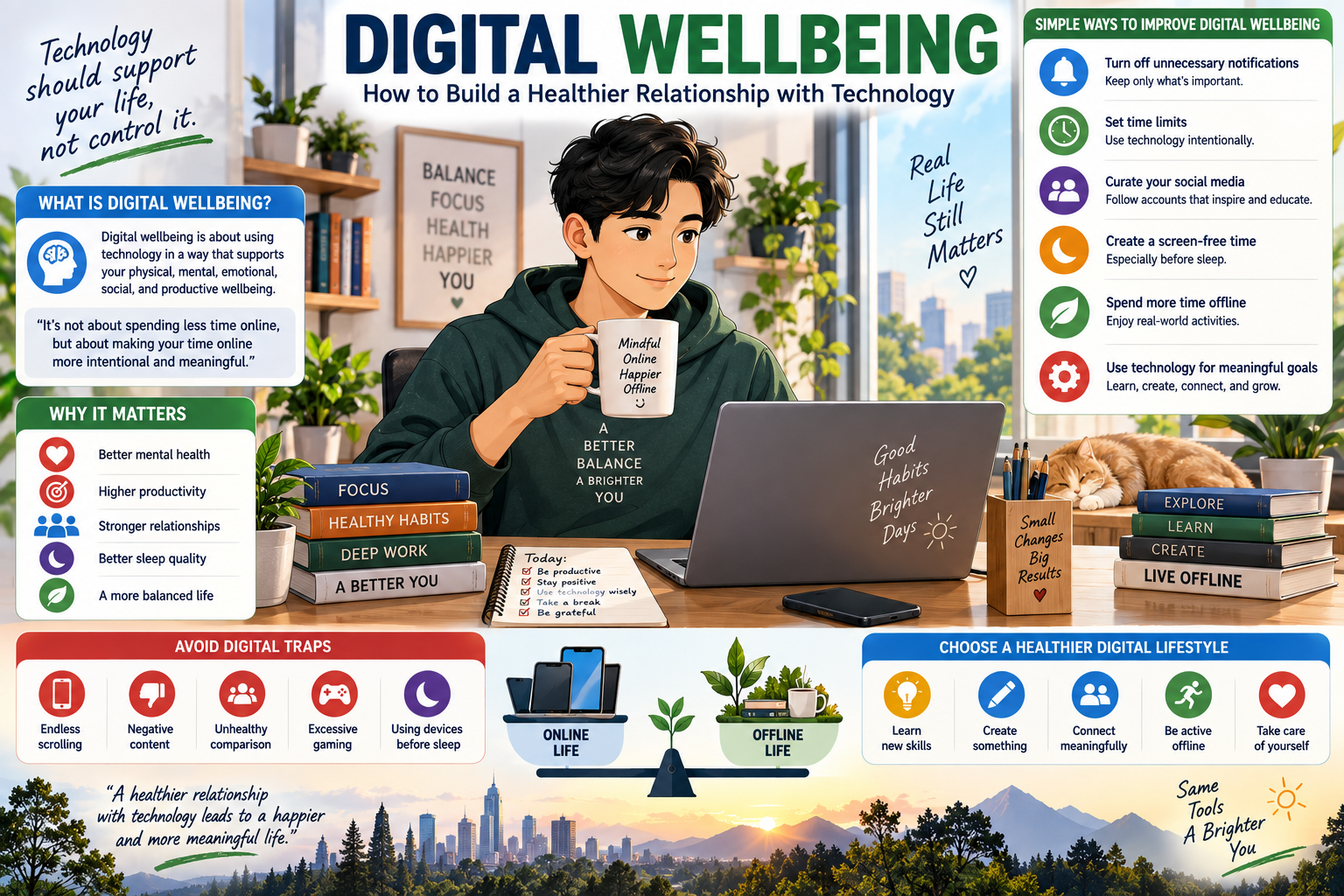
Technology has become an essential part of modern life.
We use smartphones to communicate, computers to work, social media to stay connected, and digital platforms to learn new things.
Technology makes many activities faster and easier.
However, constant access to digital devices can also create new challenges.
People may spend hours scrolling through social media, checking notifications, watching short videos, or switching between different applications without realizing how much time has passed.
The problem is not technology itself.
The real challenge is learning how to use technology intentionally and responsibly.
This is where the concept of digital wellbeing becomes important.
Digital wellbeing is about developing a healthier relationship with technology so that digital tools support our lives rather than control our attention.
What Is Digital Wellbeing?
Digital wellbeing refers to the way technology affects our physical, mental, emotional, and social wellbeing.
It involves understanding:
• how much time we spend online;
• what type of content we consume;
• how technology affects our concentration;
• how digital habits influence our sleep;
• how social media affects our emotions;
• whether technology helps or distracts us.
Digital wellbeing does not mean completely avoiding technology.
Instead, it means using technology in a way that supports our goals and quality of life.
Technology Is a Tool, Not a Master
A smartphone can be extremely useful.
It can become:
• a communication device;
• a learning tool;
• a navigation system;
• a digital camera;
• a productivity assistant;
• a source of information.
But the same device can also become a major source of distraction.
The difference often depends on how intentionally we use it.
A useful question is:
Am I using technology because I need it, or because I am simply used to checking it?
That small question can reveal a lot about our digital habits.
Why Digital Distraction Happens
Many digital platforms are designed to capture attention.
Notifications, recommendations, endless feeds, and short-form content encourage users to continue interacting.
One video leads to another.
One notification leads to another application.
A few minutes can easily become an hour.
This does not necessarily mean that people lack discipline.
Digital environments are often designed to make continued engagement very easy.
Therefore, building healthier habits requires conscious decisions.
The Attention Economy
Attention has become an important resource in the digital world.
Many online services compete for users’ attention because attention can generate:
• advertising revenue;
• engagement;
• subscriptions;
• purchases;
• data;
• platform growth.
As a result, users are constantly exposed to content competing for their attention.
Learning to protect attention has therefore become an important modern skill.
Digital Wellbeing and Productivity
Constant notifications can interrupt concentration.
Imagine working on an important task.
A notification appears.
You check your phone.
Then you open a message.
After that, you check social media.
A few minutes later, you return to your original task.
Although the interruption may seem small, repeated interruptions can make focused work more difficult.
This is why digital wellbeing is closely connected to productivity.
Create Technology-Free Focus Periods
One simple strategy is to create specific periods for focused work.
For example:
30–60 minutes of focused work
followed by
5–10 minutes of intentional rest.
During the focus period, unnecessary notifications can be turned off.
The goal is not to eliminate every digital device.
The goal is to protect attention from unnecessary interruptions.
Turn Off Unnecessary Notifications
Not every notification deserves immediate attention.
Consider disabling notifications for applications that are not essential.
Keep only important alerts.
This creates a simple principle:
Important → Notify
Unimportant → Wait
Instead of allowing every application to interrupt your day, you decide what deserves your attention.
Build a Healthier Relationship with Social Media
Social media can provide many benefits.
It can help people:
• communicate;
• learn;
• promote businesses;
• discover opportunities;
• build communities;
• share creative work.
However, excessive use may also create problems.
Users may compare themselves with others, become overwhelmed by information, or spend more time online than intended.
The solution is not necessarily deleting every social media account.
Instead, users can become more intentional about what they follow and how they use these platforms.
Curate Your Digital Environment
Your digital environment influences what you see every day.
If your feed is filled with:
• negativity;
• unnecessary arguments;
• excessive advertisements;
• unhealthy comparisons;
your online experience may become stressful.
Consider following accounts that provide:
• useful information;
• education;
• inspiration;
• creativity;
• positive communities.
You cannot control everything on the internet.
But you can control many parts of your digital environment.
Avoid Endless Scrolling
Short-form content is convenient and entertaining.
However, endless scrolling can make it difficult to recognize when entertainment has become excessive.
One useful strategy is to create a stopping point.
For example:
“I will watch for 20 minutes.”
Then stop when the planned period ends.
The goal is to make consumption intentional rather than automatic.
Digital Wellbeing and Sleep
Technology can also influence nighttime routines.
Many people use smartphones immediately before sleeping and immediately after waking.
A simple habit can help:
Create a screen-free period before bedtime.
Instead of scrolling, consider:
• reading a physical book;
• writing a journal;
• preparing for tomorrow;
• stretching;
• talking with family;
• practicing relaxation.
The specific activity matters less than creating a transition away from constant digital stimulation.
Do Not Start the Day with Notifications
For some people, the first activity of the morning is checking notifications.
This can immediately expose the mind to messages, news, social media, and other people’s priorities.
An alternative is to create a short morning routine before checking non-essential notifications.
For example:
Wake Up → Drink Water → Prepare → Plan the Day → Check Messages
This gives the individual more control over the beginning of the day.
Digital Wellbeing for Students
Students face particular challenges because technology is increasingly important for education.
A laptop may be needed for assignments.
A smartphone may be needed for communication.
Online platforms may be required for learning.
The challenge is distinguishing:
Technology for learning
from
Technology that distracts from learning.
Students can create separate periods for study and entertainment.
Use the Internet Intentionally for Learning
Instead of opening a browser without a clear goal, start with a question.
For example:
“What do I need to understand?”
Then search for information related to that question.
This simple approach reduces unnecessary browsing.
It also turns internet use into a more active learning process.
The Two-Minute Digital Rule
Before opening an application, ask:
“What am I going to do here?”
If you cannot answer the question, you may not actually need to open it.
For example:
Instead of:
“I will check Instagram.”
Try:
“I will reply to three messages.”
The second statement has a clear purpose.
Once the purpose is completed, you can close the application.
Digital Minimalism
Digital minimalism is an approach that encourages people to focus on technologies that provide meaningful value.
It does not necessarily mean owning fewer devices.
It means being more selective about digital activities.
Ask:
Does this technology help me achieve something important?
If the answer is yes, use it intentionally.
If the answer is no, consider reducing its role in your daily life.
Quality Matters More Than Quantity
Spending many hours online does not automatically mean technology is harming your wellbeing.
Someone may spend several hours online:
• studying;
• working;
• creating content;
• attending online classes;
• communicating with family.
Another person may spend one hour scrolling without purpose and feel exhausted afterward.
Therefore, screen time is only one part of the picture.
The quality and purpose of digital activity also matter.
Technology and Relationships
Digital communication can help maintain relationships across long distances.
Messages, video calls, and online communities can connect people who cannot meet physically.
However, digital communication should complement real relationships rather than completely replace them.
Whenever possible, create time for:
• face-to-face conversations;
• family activities;
• outdoor activities;
• community involvement;
• meaningful social interaction.
Technology should help people connect, not isolate them.
Practice Digital Boundaries
Healthy digital habits require boundaries.
Examples include:
No-phone meals
No-work notifications after a certain hour
Screen-free family time
Limited social media periods
Device-free study sessions
Boundaries make it easier to control technology instead of reacting to it constantly.
Make Your Smartphone Less Distracting
A smartphone does not have to be visually optimized for constant attention.
Try simple changes:
• remove unnecessary applications;
• move distracting apps away from the home screen;
• disable non-essential notifications;
• organize applications into folders;
• use focus modes;
• set time limits where useful.
The purpose is to create small barriers against automatic behavior.
Track Your Digital Habits
Many smartphones provide screen-time information.
Instead of using the data only to feel guilty, use it as information.
Ask:
Which applications take most of my time?
When do I use them?
Why do I open them?
How do I feel afterward?
This turns screen-time data into a tool for self-reflection.
Replace Habits Instead of Simply Removing Them
Removing a digital habit may create an empty space.
For example, if someone usually spends an hour scrolling before bed, simply removing the phone may feel uncomfortable.
It can be easier to replace the habit with something else.
Try:
Scrolling → Reading
Random browsing → Learning
Late-night videos → Journaling
Constant notifications → Scheduled checking
Replacing a habit can make change more sustainable.
The Importance of Offline Activities
A healthy digital lifestyle should include meaningful offline activities.
Examples include:
• walking;
• exercising;
• reading;
• gardening;
• cooking;
• learning a practical skill;
• spending time with family;
• participating in community activities.
Offline experiences provide opportunities to rest from constant digital stimulation.
Digital Wellbeing at Work
Organizations can also contribute to healthier digital habits.
Companies may establish:
• clear communication expectations;
• reasonable response times;
• focused meeting practices;
• fewer unnecessary notifications;
• clear boundaries outside working hours.
Productivity does not necessarily mean being available every minute.
Sometimes, protecting focused work is more valuable than responding instantly to every message.
Parents and Children’s Digital Habits
Children are growing up in an increasingly digital environment.
Parents do not only need to control screen time.
They can also teach children:
• how to evaluate online information;
• how to communicate respectfully;
• how to protect privacy;
• how to recognize inappropriate content;
• how to balance online and offline activities.
Most importantly, children learn from example.
If adults constantly check their phones during family conversations, children may naturally copy that behavior.
Digital Literacy and Digital Wellbeing
Digital literacy is not only about knowing how to use applications.
It also includes understanding:
• how algorithms influence content;
• how misinformation spreads;
• how online advertising works;
• how personal data is collected;
• how digital behavior affects wellbeing.
A digitally literate person does not simply know how to use technology.
They understand how technology influences their decisions and behavior.
Beware of Digital Comparison
Social media often shows carefully selected moments.
People usually share:
• achievements;
• vacations;
• celebrations;
• successful projects;
• beautiful photographs.
They may not share:
• failures;
• uncertainty;
• financial difficulties;
• personal struggles;
• ordinary days.
Comparing your complete life with someone else’s carefully selected highlights can create unrealistic expectations.
Remember:
A social media feed is not a complete picture of a person’s life.
Use Technology to Create, Not Only Consume
One of the best ways to improve digital wellbeing is to shift from passive consumption toward meaningful creation.
Instead of only:
Watch → Scroll → Like → Repeat
try:
Learn → Create → Share → Improve
You could:
• write an article;
• create educational content;
• design graphics;
• record a tutorial;
• learn programming;
• build a small business;
• create music.
Creation gives technology a more purposeful role.
A Simple Digital Wellbeing Routine
A practical daily routine might look like this:
Morning
Avoid unnecessary notifications immediately after waking.
Work or Study
Use focused periods with limited interruptions.
Afternoon
Check messages and social media intentionally.
Evening
Reduce unnecessary screen activity.
Before Bed
Create a short screen-free period.
The exact schedule can be adjusted according to individual needs.
A Seven-Day Digital Wellbeing Challenge
You can start with a simple seven-day experiment.
Day 1
Check your current screen-time habits.
Day 2
Turn off unnecessary notifications.
Day 3
Create one focused, distraction-free work session.
Day 4
Unfollow accounts that consistently create unnecessary negativity.
Day 5
Create a screen-free period before bedtime.
Day 6
Replace one scrolling session with an offline activity.
Day 7
Review what changed.
The goal is not perfection.
The goal is awareness and improvement.
Questions for Digital Self-Reflection
At the end of the day, ask:
- What did technology help me accomplish today?
- Which digital activity consumed more time than expected?
- Did I use social media intentionally?
- Did technology interrupt my important activities?
- Did I spend enough time offline?
- What digital habit would I like to change tomorrow?
Five minutes of reflection can reveal patterns that are difficult to notice during a busy day.
Digital Wellbeing Is About Balance
Technology is not the enemy.
The internet is not the enemy.
Social media is not automatically harmful.
The real issue is whether our digital habits align with what matters to us.
Technology should help us:
Learn
Work
Connect
Create
Solve Problems
Grow
It should not automatically determine where our attention goes every minute.
The Future of Digital Wellbeing
As artificial intelligence, smart devices, virtual environments, and digital services continue to develop, technology will become even more integrated into everyday life.
That makes digital wellbeing increasingly important.
Future digital skills will not only include knowing how to use technology.
They will also include knowing:
When to use it, why to use it, and when to put it away.
That may become one of the most important forms of digital maturity.
Final Thoughts
Technology has transformed the way we work, study, communicate, and entertain ourselves.
Its benefits are enormous.
But greater access also requires greater awareness.
Digital wellbeing does not require abandoning modern technology.
It requires developing a healthier relationship with it.
Turn off unnecessary notifications.
Protect your attention.
Create meaningful boundaries.
Choose what you consume.
Make time for offline experiences.
And most importantly, use technology according to your priorities rather than allowing technology to determine your priorities.
The goal is not to spend less time online simply for the sake of spending less time online.
The goal is to make the time we spend with technology more intentional, meaningful, and beneficial.
Because technology should be part of our lives.
It should not become our entire life.
FAQ
What is digital wellbeing?
Digital wellbeing is the practice of using technology in a way that supports physical, mental, emotional, social, and productive wellbeing.
Is digital wellbeing about reducing screen time?
Not necessarily. Screen time is only one factor. The purpose and quality of digital activity are also important.
How can I improve my digital wellbeing?
Start by turning off unnecessary notifications, creating focused periods, setting digital boundaries, curating your social media feeds, and making time for offline activities.
Why are notifications distracting?
Notifications interrupt attention and can encourage people to repeatedly check their devices even when there is no urgent need.
Is social media always bad for wellbeing?
No. Social media can support communication, learning, communities, creativity, and business. The key is using it intentionally and maintaining healthy boundaries.
How can students improve digital wellbeing?
Students can separate study and entertainment time, minimize unnecessary notifications, use technology with clear learning goals, and create distraction-free study sessions.