
Introduction
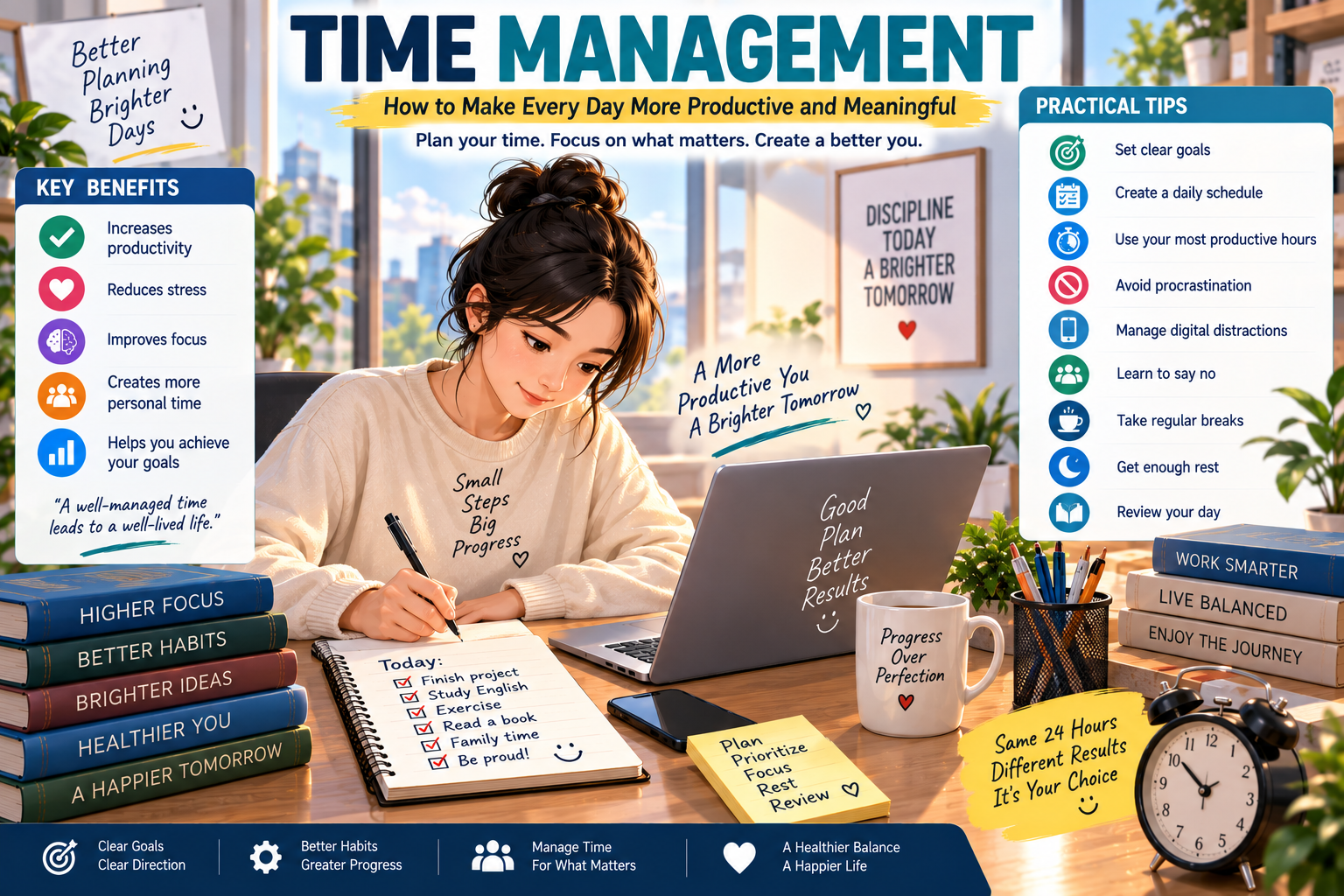
Time is one of the most valuable resources in life. Everyone has the same twenty-four hours each day, but people often use those hours in very different ways.
Some people can complete important tasks, spend time with their families, learn new skills, and still have time to rest. Others may feel busy throughout the day but finish it wondering where their time went.
The difference is often not the amount of time available, but how that time is managed.
Time management is the ability to organize and prioritize activities so that important goals can be achieved without unnecessary stress. Good time management does not mean filling every minute with work. Instead, it means using time intentionally.
In a world filled with notifications, social media, meetings, assignments, and countless responsibilities, learning how to manage time has become an essential life skill.
What Is Time Management?
Time management is the process of planning and organizing how you spend your available time.
It involves deciding:
• what needs to be done;
• which tasks are most important;
• when each task should be completed;
• how much time should be allocated to different activities;
• which activities can be delayed, delegated, or eliminated.
Effective time management allows people to focus their energy on activities that truly matter.
It is especially useful for students, employees, entrepreneurs, teachers, parents, and anyone who has multiple responsibilities.
Why Is Time Management Important?
Poor time management can create unnecessary pressure.
When important tasks are continually postponed, they may eventually accumulate. A simple responsibility can become overwhelming when combined with several other unfinished tasks.
Good time management can provide several benefits.
- It Increases Productivity
Productivity is not about working as much as possible. It is about making meaningful progress on important tasks.
When priorities are clear, people spend less time deciding what to do next and more time actually doing it. - It Reduces Stress
A crowded schedule can make people feel overwhelmed.
Planning tasks in advance creates a clearer picture of what needs to be done. Instead of carrying every responsibility in your mind, you can organize them into a manageable plan. - It Improves Focus
Multitasking often creates the illusion of productivity.
Moving constantly between different tasks can make it harder to concentrate. A structured schedule encourages people to focus on one important activity at a time. - It Creates More Personal Time
Good time management is not only about work.
When important responsibilities are completed efficiently, people can create more space for hobbies, exercise, family, friends, and relaxation.
The Difference Between Being Busy and Being Productive
One of the biggest misunderstandings about productivity is believing that being busy automatically means being productive.
A person may spend eight hours working but accomplish very little because of constant interruptions, unnecessary meetings, excessive social media use, or unclear priorities.
Being busy means having many activities.
Being productive means making meaningful progress toward important goals.
This distinction is essential.
Instead of asking:
“How much did I do today?”
try asking:
“What important progress did I make today?”
The second question encourages people to focus on results rather than simply activity.
How to Create an Effective Daily Schedule
A good schedule does not need to be complicated.
Start by writing down everything that needs to be done. Then divide the tasks according to their importance.
A simple system can include three categories:
High Priority
These are tasks that are important and usually have clear deadlines.
Examples include:
• important work projects;
• exams;
• business responsibilities;
• financial obligations;
• urgent family matters.
Medium Priority
These tasks are useful but may not require immediate attention.
Examples include:
• organizing files;
• planning future activities;
• responding to non-urgent messages;
• learning additional skills.
Low Priority
These activities can often be postponed or reduced.
Examples include:
• excessive scrolling;
• unnecessary online browsing;
• repetitive checking of notifications;
• activities that provide little meaningful value.
This simple classification can make a busy day much easier to manage.
Set Clear Goals
Time management becomes easier when you know what you want to accomplish.
Instead of setting a vague goal such as:
“I want to study more.”
create a clearer goal:
“I will study English vocabulary for thirty minutes after dinner.”
A specific goal tells you what to do and when to do it.
Clear goals also make it easier to measure progress.
Use the Most Productive Hours Wisely
Everyone has different periods when they feel more energetic and focused.
Some people work best in the morning. Others become more productive in the afternoon or evening.
Identify your most productive hours and use them for activities that require concentration.
For example, difficult writing, studying, strategic planning, or problem-solving can be scheduled during periods when your mental energy is highest.
Less demanding activities can be placed during lower-energy periods.
Learn to Say No
One of the most important parts of time management is understanding that you cannot do everything.
People sometimes accept too many responsibilities because they are afraid of disappointing others.
However, saying yes to every request can leave little time for your own priorities.
Learning to say “no” politely and appropriately can protect your time and energy.
It does not mean being selfish. It means understanding your limits.
Avoid Procrastination
Procrastination is one of the biggest enemies of effective time management.
It happens when people delay important tasks even though they know those tasks need to be completed.
A useful strategy is to make the first step extremely small.
Instead of thinking:
“I need to finish this entire project.”
think:
“I will work on it for ten minutes.”
Starting is often harder than continuing.
Once you begin, the task may feel less difficult than you originally imagined.
Manage Digital Distractions
Modern technology can make life easier, but it can also consume large amounts of time.
Notifications, social media, short videos, games, and constant messages can interrupt concentration.
Consider creating specific periods for checking messages and social media instead of checking them continuously.
You can also:
• turn off unnecessary notifications;
• keep your phone away during focused work;
• use website or app limits;
• avoid opening social media during important tasks;
• create technology-free periods before sleeping.
The goal is not to eliminate technology but to make sure that technology serves your priorities rather than controlling your attention.
Try the Time-Blocking Method
Time blocking is a simple technique in which specific periods are assigned to specific activities.
For example:
| Time | Activity |
| 06:00–07:00 | Morning routine |
| 07:00–09:00 | Focused work or study |
| 09:00–09:30 | Break |
| 09:30–12:00 | Main tasks |
| 12:00–13:00 | Lunch and rest |
| 13:00–15:00 | Meetings or secondary tasks |
| 15:00–16:00 | Review and administration |
| Evening | Family, hobbies, and relaxation |
The exact schedule will be different for everyone.
The important principle is to give important activities a specific place in your day.
Take Regular Breaks
Working continuously for hours does not necessarily produce better results.
Short breaks can help refresh your mind and maintain concentration.
During a break, consider stepping away from your screen, walking, stretching, drinking water, or simply resting for a few minutes.
A good work rhythm should include both focused activity and adequate recovery.
Do Not Forget Rest
Rest is sometimes treated as wasted time.
That is a mistake.
Sleep and relaxation are important parts of maintaining energy and concentration.
A person who constantly sacrifices sleep in the name of productivity may eventually experience reduced focus, motivation, and performance.
Effective time management therefore includes time for rest.
The goal is not to create a life where every minute is productive.
The goal is to create a life where important things receive the attention they deserve.
Review Your Day
At the end of the day, spend a few minutes reviewing your activities.
Ask yourself:
• What did I accomplish today?
• Which task was most important?
• What distracted me?
• What could I have done differently?
• What should I prioritize tomorrow?
This simple reflection can gradually improve your ability to manage time.
You do not need a perfect schedule.
You need a system that becomes better through continuous adjustment.
Common Time Management Mistakes
Several habits can make time management more difficult.
Trying to Do Everything at Once
Too many priorities usually mean that nothing receives enough attention.
Choose the most important tasks first.
Making an Unrealistic Schedule
A schedule packed from morning until night may look impressive, but unexpected situations are part of everyday life.
Leave some flexibility.
Ignoring Small Tasks
Small tasks can accumulate and eventually become stressful.
Allocating a specific time to handle them can prevent unnecessary buildup.
Spending Too Much Time Planning
Planning is useful, but planning should support action.
Do not spend an hour designing the perfect schedule if you could use that hour to complete an important task.
Forgetting Personal Life
A schedule focused entirely on work may increase productivity temporarily but create an unhealthy lifestyle in the long term.
Time for family, relationships, hobbies, exercise, and rest also matters.
Time Management for Students
Students often have to balance classes, assignments, examinations, organizations, social activities, and personal responsibilities.
A simple weekly study plan can make a significant difference.
Students can divide larger assignments into smaller tasks.
For example:
Monday: Research
Tuesday: Create an outline
Wednesday: Write the first section
Thursday: Complete the main content
Friday: Review and edit
Breaking a large assignment into smaller steps makes it less intimidating and reduces last-minute pressure.
Time Management for Professionals
Employees often face meetings, emails, deadlines, projects, and unexpected requests.
A useful approach is to identify the most important work before the day becomes filled with interruptions.
Try to protect periods of uninterrupted focus for tasks that require deep concentration.
Email and routine administrative work can often be grouped into specific periods rather than checked constantly.
Time Management for Entrepreneurs
Business owners have another challenge: there is always something that could be done.
Marketing, customer service, finances, operations, product development, and administration can easily consume the entire day.
Entrepreneurs should distinguish between activities that directly contribute to business growth and activities that simply keep them busy.
Delegation and automation can also help business owners focus on higher-value responsibilities.
A Simple Time Management Formula
An effective daily system can be summarized in five steps:
Plan → Prioritize → Focus → Rest → Review
Plan
Decide what needs to be done.
Prioritize
Determine what matters most.
Focus
Work on important tasks without unnecessary distractions.
Rest
Give your mind and body enough recovery time.
Review
Evaluate the day and improve tomorrow’s plan.
This formula is simple, but consistency is more important than complexity.
Conclusion
Time management is not about controlling every minute of your life.
It is about making conscious decisions about where your time, attention, and energy should go.
By setting clear goals, prioritizing important tasks, reducing distractions, avoiding procrastination, taking regular breaks, and making time for rest, you can create a healthier and more productive daily routine.
The most successful time management system is not necessarily the most complicated one. It is the system you can realistically maintain.
Remember that time cannot be stored or recovered. Once a day has passed, it cannot be repeated.
Therefore, learning to manage time is ultimately about learning to manage one of the most valuable parts of life.
FAQ
What is time management?
Time management is the process of planning, organizing, and prioritizing activities so that important goals can be achieved effectively.
Why is time management important?
Good time management can improve productivity, reduce stress, increase focus, and create more time for personal activities and rest.
How can I stop procrastinating?
Start with a very small step. Instead of focusing on completing the entire task, commit to working on it for a short period. Starting often makes the task feel easier.
What is time blocking?
Time blocking is a scheduling technique in which specific periods of the day are assigned to specific activities.
Is multitasking good for productivity?
Multitasking can reduce concentration when tasks require significant mental attention. Focusing on one important task at a time is often more effective.
How can students improve time management?
Students can create weekly schedules, break large assignments into smaller steps, prioritize deadlines, limit distractions, and review their progress regularly.
Does time management mean working all day?
No. Effective time management includes work, study, rest, family, hobbies, and other meaningful activities. The goal is balance and intentional use of time.