
Introduction
Life does not always follow the plans we make.
Sometimes we achieve what we want. At other times, we experience failure, disappointment, rejection, financial difficulties, unexpected changes, or situations that are completely outside our control.
These experiences are part of life.
What makes people different is not whether they experience difficulties, but how they respond to them.
Some people may feel discouraged after a difficult experience and struggle to move forward. Others may need time to recover, reflect on what happened, and gradually rebuild their confidence.
The ability to adapt, recover, and continue moving forward is often described as resilience.
Resilience does not mean that a person never feels sad, afraid, disappointed, or tired.
Instead, resilience means developing the ability to face difficulties while continuing to learn, adapt, and look for constructive ways forward.
What Is Resilience?
Resilience is the capacity to adapt to difficult situations and recover after experiencing challenges or setbacks.
A resilient person is not necessarily someone who is always strong or positive.
A resilient person can experience difficult emotions but does not allow those emotions to completely determine the direction of their life.
For example, a student who fails an examination may feel disappointed.
A resilient response could be:
“I am disappointed with the result, but I want to understand what went wrong and improve my preparation.”
The failure remains real.
However, the person chooses to respond to it as part of a learning process.
Why Is Resilience Important?
Modern life is full of uncertainty.
Technology changes rapidly. Careers evolve. Businesses face competition. Students encounter academic pressure. Families experience unexpected challenges.
Because change is unavoidable, resilience has become an important life skill.
- Resilience Helps Us Recover
Difficult experiences can affect our emotions and motivation.
Resilience helps us gradually regain balance and continue with our responsibilities. - Resilience Helps Us Adapt
Sometimes the solution is not to return to the exact situation we had before.
Instead, we need to adapt to a new reality.
For example, a business that loses customers may need to change its marketing strategy rather than simply repeat the same approach. - Resilience Encourages Learning
Challenges can provide valuable information.
A failure can reveal weaknesses in a strategy.
A difficult experience can teach us about our limits, strengths, habits, and decision-making. - Resilience Builds Long-Term Confidence
Confidence does not always come from winning.
Sometimes confidence grows when we realize:
“I have faced difficult situations before, and I learned how to deal with them.”
Past experiences can become evidence that we are capable of handling future challenges.
Resilience Is Not the Same as Being Emotionless
One common misunderstanding is that resilient people should always appear strong.
That is not true.
A resilient person can feel:
• sadness;
• fear;
• frustration;
• disappointment;
• uncertainty;
• exhaustion.
The important part is how the person responds to those emotions.
Ignoring emotions does not necessarily make someone stronger.
Recognizing emotions can be the first step toward understanding what needs to be done next.
The Difference Between Resilience and Giving Up
Resilience does not mean continuing with the exact same strategy forever.
Sometimes resilience means changing direction.
Imagine an entrepreneur who has tried to sell a product through one marketing channel for months without meaningful results.
Continuing exactly the same way may not be resilience.
A more resilient approach could be:
- evaluate the results;
- identify the problem;
- learn from feedback;
- change the strategy;
- test a new approach;
- continue improving.
The goal is not simply to keep going.
The goal is to keep moving forward intelligently.
How to Build Resilience
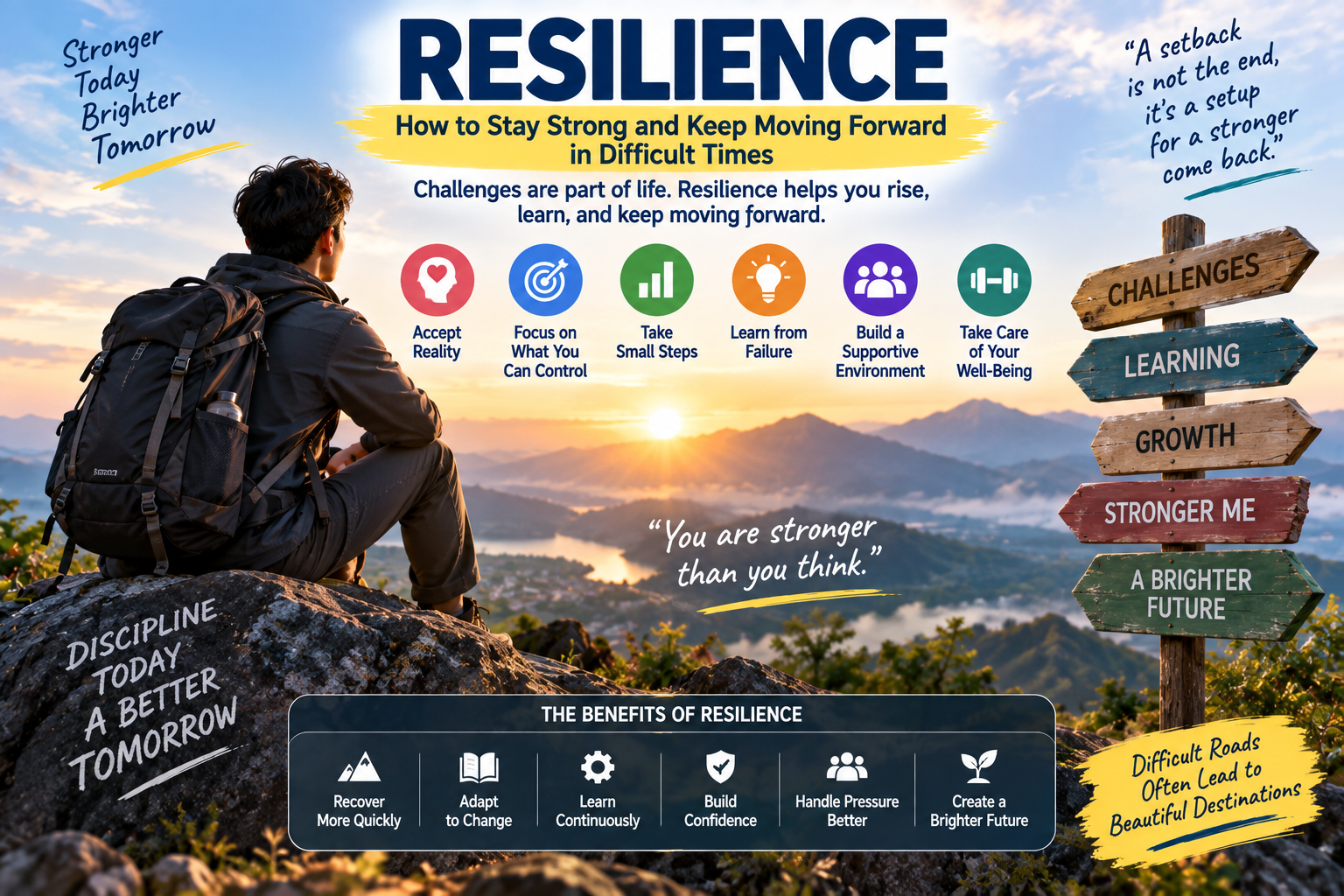
Resilience can be strengthened through everyday habits. - Accept Reality
The first step is accepting that a difficult situation has happened.
Acceptance does not mean agreeing that something is good.
It means recognizing reality so that you can decide what to do next.
Instead of spending all your energy asking:
“Why did this happen to me?”
you can gradually move toward:
“What can I do from this point?”
That question creates space for action. - Focus on What You Can Control
Not everything is under our control.
We cannot control every person’s opinion, every economic condition, every unexpected event, or every outcome.
But we can often control:
• our preparation;
• our effort;
• our attitude;
• our communication;
• our next decision;
• how we respond to a problem.
Focusing on controllable factors can reduce unnecessary mental pressure. - Break Big Problems into Smaller Steps
A large problem can feel overwhelming when viewed as one huge challenge.
Breaking it into smaller actions can make it easier to manage.
For example:
Instead of:
“I need to fix my entire business.”
Start with:
• review sales data;
• identify the weakest product;
• contact several customers;
• evaluate marketing costs;
• create one new promotion;
• review the results.
Small actions create movement. - Learn from Failure
Failure does not automatically make someone better.
Learning from failure does.
After something goes wrong, ask:
• What happened?
• What caused the problem?
• What was under my control?
• What did I learn?
• What should I change?
• What should I avoid repeating?
Reflection turns experience into knowledge.
Build a Supportive Environment
Resilience does not mean solving every problem alone.
Human beings need relationships.
Family members, friends, colleagues, teachers, mentors, and communities can provide emotional support, practical advice, or simply a place to talk.
Asking for help is not necessarily a sign of weakness.
Sometimes seeking support is a responsible way to manage a difficult situation.
Develop Healthy Daily Habits
Physical and mental energy influence how we respond to challenges.
Simple habits can support resilience, including:
• getting enough sleep;
• maintaining regular physical activity;
• eating adequately;
• taking meaningful breaks;
• maintaining social connections;
• creating time for reflection;
• managing digital distractions.
These habits do not eliminate problems.
They can, however, provide a stronger foundation for dealing with them.
Resilience in Education
Students experience many forms of pressure.
They may face:
• difficult subjects;
• examination results;
• competition;
• social challenges;
• uncertainty about the future;
• fear of failure.
Resilience can help students understand that one poor result does not define their entire ability.
For example, a student who receives a low score can review the learning process instead of immediately concluding:
“I am not intelligent.”
A better question is:
“Which part of the material do I not understand yet?”
This approach turns a disappointing result into an opportunity for improvement.
Resilience in the Workplace
The workplace can involve deadlines, changing priorities, demanding customers, organizational changes, and unexpected problems.
Employees with resilience can adapt more effectively when circumstances change.
For example, if a project changes direction, a resilient employee can:
- understand the new objective;
- identify what has changed;
- adjust the plan;
- communicate with the team;
- continue working toward the new goal.
Resilience does not eliminate workplace stress, but it can help people respond to change more constructively.
Resilience in Business
Entrepreneurs often experience uncertainty.
A business may have a successful month followed by a difficult period.
Customers can change their preferences. Competitors can introduce new products. Technology can disrupt traditional business models.
Resilient entrepreneurs understand that business development is rarely a perfectly straight line.
They monitor results, learn from customers, adjust strategies, and continue experimenting.
The important principle is:
Do not confuse one difficult period with the end of the entire journey.
Resilience and Change
Change can be uncomfortable because it creates uncertainty.
People often prefer familiar situations even when those situations are no longer effective.
Resilience involves developing the ability to say:
“This situation is different now. What do I need to learn?”
That question transforms change from something that must simply be resisted into something that can be understood and managed.
Resilience and Problem Solving
Resilience becomes stronger when combined with practical problem-solving skills.
When facing a challenge, try this simple process:
Identify → Analyze → Plan → Act → Review
Identify
Clearly define the problem.
Analyze
Find the causes and available information.
Plan
Determine possible solutions.
Act
Choose a reasonable action and implement it.
Review
Evaluate the result and make adjustments.
This process prevents emotional reactions from becoming the only basis for decision-making.
The Importance of Patience
Recovery does not always happen quickly.
Some problems can be solved in a day.
Others require weeks, months, or even longer.
Expecting immediate results can create additional frustration.
Patience allows people to recognize that meaningful progress can happen gradually.
A small improvement is still improvement.
Resilience and Self-Talk
The way we talk to ourselves can influence how we respond to difficult situations.
Consider the difference between:
“Everything is ruined.”
and:
“This situation is difficult, but I can identify the next step.”
The second statement does not deny the problem.
It simply creates a more constructive way of approaching it.
Healthy self-talk should be realistic rather than artificially positive.
Instead of saying:
“Nothing can go wrong.”
say:
“Problems may happen, but I can prepare and respond to them.”
Do Not Compare Your Recovery with Others
People recover from difficult situations at different speeds.
One person may quickly return to normal after a setback.
Another person may need more time.
Comparing your recovery process with someone else’s can create unnecessary pressure.
Focus on your own progress.
Ask:
“Am I moving forward compared with where I was before?”
That is often a more useful measure.
Resilience and Personal Growth
Difficult experiences can sometimes reveal abilities that we did not know we had.
A person may discover that they can:
• remain calm under pressure;
• learn new skills;
• communicate more clearly;
• manage uncertainty;
• become more independent;
• ask for help;
• adapt to change.
This does not mean that difficult experiences are always good.
Rather, it means that people can sometimes find opportunities for learning even in difficult circumstances.
A Simple Resilience Routine
A practical daily routine can include five questions:
- What is challenging me today?
Identify the problem. - What can I control?
Separate controllable and uncontrollable factors. - What is one useful action I can take?
Choose a realistic next step. - What can I learn from this situation?
Turn experience into knowledge. - Who can support me?
Remember that you do not always have to solve everything alone.
Resilience Does Not Mean Never Asking for Help
There are situations that require professional or specialized support.
If someone is experiencing serious and persistent difficulties that interfere with daily functioning, seeking appropriate professional support can be an important and responsible step.
Resilience is not about proving that you can handle everything alone.
Sometimes resilience means recognizing when additional support is needed.
Building Resilience in Children and Young People
Resilience can be encouraged from an early age.
Parents and teachers can help children by:
• allowing them to solve age-appropriate problems;
• encouraging them to try again;
• teaching them how to reflect on mistakes;
• avoiding excessive fear of failure;
• recognizing effort and improvement;
• providing a safe environment for asking questions.
Children need both support and opportunities to develop independence.
Small Actions Create Stronger Resilience
Resilience does not have to begin with a dramatic transformation.
It can start with small actions:
• finishing one difficult task;
• trying again after a mistake;
• asking for help;
• learning one new skill;
• taking a necessary break;
• having an honest conversation;
• reviewing a failed plan;
• starting again tomorrow.
Over time, these small actions can strengthen a person’s ability to deal with challenges.
Conclusion
Resilience is the ability to adapt, recover, learn, and continue moving forward when life becomes difficult.
It does not mean being emotionless, pretending that everything is fine, or refusing to ask for help.
Instead, resilience involves accepting reality, focusing on what can be controlled, learning from experience, adjusting strategies, maintaining supportive relationships, and taking meaningful steps forward.
Students can use resilience when facing academic challenges. Employees can use it when dealing with change. Entrepreneurs can use it when navigating uncertainty. Families can use it when managing difficult circumstances.
Life will always contain uncertainty.
We cannot control every challenge that comes our way.
But we can continue developing the ability to respond wisely.
Sometimes progress is not about moving quickly.
Sometimes progress simply means standing up, learning from yesterday, and taking the next step.
FAQ
What is resilience?
Resilience is the ability to adapt to difficult situations, recover from setbacks, learn from experience, and continue moving forward.
Is resilience something people are born with?
People may have different natural tendencies, but resilience can also be developed through experience, habits, relationships, reflection, and learning.
Does being resilient mean never feeling sad?
No. Resilient people can experience sadness, fear, disappointment, and frustration. Resilience concerns how they respond to those experiences.
How can students develop resilience?
Students can develop resilience by learning from mistakes, breaking difficult tasks into smaller steps, asking for help, practicing regularly, and reflecting on their learning process.
How can entrepreneurs become more resilient?
Entrepreneurs can build resilience by monitoring business results, learning from failure, adapting strategies, listening to customers, managing resources carefully, and maintaining a willingness to learn.
Can resilience be developed through small habits?
Yes. Small habits such as reflection, completing difficult tasks, asking for support, maintaining healthy routines, and learning from mistakes can contribute to resilience over time.
Is asking for help a sign of weakness?
Not necessarily. Seeking appropriate support can be a responsible response to a difficult situation and can help people manage challenges more effectively.