
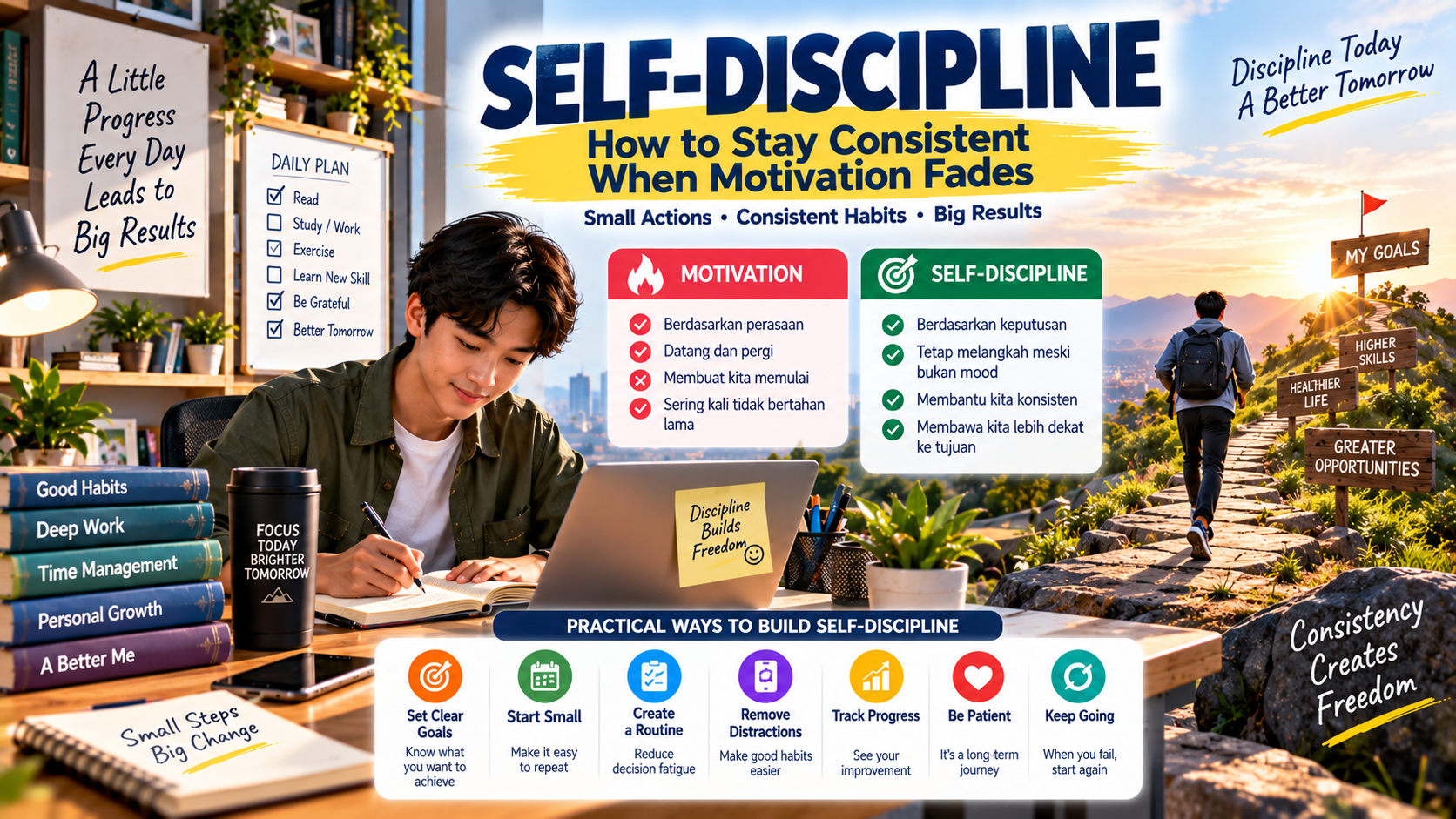
Motivation feels powerful when it is present.
You may feel excited when starting a new project, learning a new skill, building a business, exercising, or pursuing a personal goal. At the beginning, everything can feel fresh and inspiring.
But motivation does not always last.
There are days when you feel tired, distracted, bored, or uncertain. On those days, continuing becomes much harder.
This is where self-discipline becomes important.
Self-discipline is the ability to continue doing what needs to be done even when you do not feel motivated to do it.
It does not mean forcing yourself to work without rest. Instead, it means learning how to manage your choices, habits, attention, and actions so that they remain connected to your goals.
What Is Self-Discipline?
Self-discipline is the ability to regulate your behavior and consistently take actions that support your goals and responsibilities.
A disciplined person does not necessarily feel motivated all the time.
The difference is that motivation is largely connected to how you feel, while discipline helps you act according to what you have decided is important.
For example, a student may not feel like studying today.
However, if studying for an upcoming examination is important, the student may still spend 30 minutes reviewing the material.
That is self-discipline.
Motivation vs. Self-Discipline
Motivation and discipline are related, but they are not the same.
Motivation answers:
“Why do I want to do this?”
Discipline answers:
“What will I do even when I do not feel like doing it?”
Motivation can help you start.
Discipline helps you continue.
Imagine someone wants to write a book.
The initial idea may create strong excitement. The person buys a notebook, creates a writing schedule, and feels inspired.
After several weeks, however, the excitement may decrease.
The writing process becomes repetitive.
At that point, discipline becomes more important than initial enthusiasm.
Why Self-Discipline Matters
Self-discipline can influence many areas of life.
It can help people:
• study consistently;
• manage their time;
• complete important tasks;
• control unnecessary spending;
• maintain healthy routines;
• develop professional skills;
• keep promises;
• build businesses;
• pursue long-term goals.
Many meaningful achievements require repeated action over a long period.
A single productive day rarely creates lasting change.
Small actions repeated consistently can be much more powerful.
Discipline Is Not About Being Perfect
One common misunderstanding is that disciplined people never fail.
That is not true.
A disciplined person can miss a workout, postpone a task, lose focus, or make a poor decision.
The important difference is what happens afterward.
Instead of saying:
“I failed, so I should stop.”
A disciplined person can say:
“I missed today. I will start again tomorrow.”
Discipline is therefore not perfection.
It is the ability to return to the right path.
The Role of Small Habits
Large goals can feel overwhelming.
Suppose someone wants to improve their English.
Saying:
“I will become fluent in English.”
is a good long-term goal, but it does not explain what should happen today.
A smaller habit is more practical:
“I will learn five new English words every morning.”
Five words may seem insignificant.
But if practiced consistently, it can create a substantial amount of learning over time.
The same principle can be applied to reading, exercise, writing, business, and professional development.
Start Smaller Than You Think
People often make their goals too ambitious.
They decide to:
• read 50 pages every day;
• exercise for two hours;
• study for five hours;
• write 3,000 words every day;
• wake up extremely early;
• completely eliminate social media.
Such goals may work temporarily, but they can become difficult to maintain.
A smaller target is often easier to repeat.
For example:
Read 10 pages.
Exercise for 20 minutes.
Write 300 words.
Study for 30 minutes.
Once the habit becomes stable, the target can gradually increase.
Create a Clear Routine
Self-discipline becomes easier when decisions do not have to be made repeatedly.
Instead of asking every day:
“When should I study?”
create a routine.
For example:
06:30–07:00 — Reading
19:00–19:30 — Study
20:00–20:30 — Writing
A routine reduces decision fatigue and creates predictable behavior.
Over time, the activity can become a normal part of the day.
Remove Unnecessary Friction
Sometimes the problem is not a lack of discipline.
The environment may simply make the desired behavior difficult.
If you want to read more, keep a book near your desk.
If you want to exercise in the morning, prepare your clothes the night before.
If you want to study without distraction, put your smartphone away.
If you want to write, prepare the document before the writing session begins.
Small environmental changes can make good habits easier to perform.
Make Bad Habits More Difficult
The same principle works in reverse.
If you want to reduce social media use, remove unnecessary notifications.
If you frequently waste time on certain websites, block them during focused work sessions.
If you tend to make unnecessary purchases, avoid saving payment information on shopping platforms.
The goal is not to rely entirely on willpower.
A well-designed environment can support self-control.
Self-Discipline and Digital Distractions
Modern technology creates a special challenge.
A smartphone can provide communication, entertainment, information, education, and work tools in one device.
But it can also constantly compete for attention.
Notifications encourage us to check messages.
Social media encourages continuous scrolling.
Short-form videos provide rapid entertainment.
The problem is not technology itself.
The problem occurs when technology controls our attention instead of serving our goals.
One practical approach is to create specific periods for checking messages and social media.
During important work, unnecessary notifications can be turned off.
The Power of Delayed Gratification
Self-discipline is closely connected to delayed gratification.
Delayed gratification means choosing a meaningful long-term benefit instead of an immediate reward.
For example:
You can watch entertainment now, or study for an examination.
You can spend money now, or save for an important goal.
You can continue scrolling, or finish an important project.
The immediate option may feel more enjoyable.
But discipline helps you consider the consequences of your choice.
The question becomes:
“Which choice will help the person I want to become?”
Self-Discipline in Education
Students can develop self-discipline through simple routines.
For example:
• creating a study schedule;
• completing assignments before deadlines;
• reviewing lessons regularly;
• limiting distractions;
• preparing for examinations early;
• reading beyond the required material.
Students should also learn that discipline does not mean studying continuously.
Rest is part of effective learning.
A sustainable routine is more useful than an extreme schedule that cannot be maintained.
Self-Discipline in Business
Entrepreneurs often have flexible schedules.
That flexibility can be an advantage, but it can also become a challenge.
Without a clear structure, a business owner may spend too much time responding to small matters while neglecting important strategic activities.
Self-discipline can help entrepreneurs maintain routines for:
• financial review;
• customer follow-up;
• product development;
• marketing;
• inventory management;
• learning;
• planning;
• evaluating business performance.
Business growth often depends on doing important tasks consistently, even when the results are not immediate.
Self-Discipline at Work
Employees also benefit from discipline.
Professional discipline can include:
• arriving on time;
• meeting deadlines;
• communicating responsibly;
• completing tasks properly;
• maintaining quality;
• continuing to learn;
• taking responsibility for mistakes.
Discipline does not mean working without boundaries.
Healthy professional discipline also includes knowing when to rest, when to ask for help, and when to prioritize important work.
How to Build Self-Discipline
Self-discipline can be developed gradually.
- Choose One Important Goal
Do not try to change everything at once.
Choose one behavior that matters.
For example:
“I want to read every day.” - Make the Action Specific
Instead of:
“I will read more.”
say:
“I will read 10 pages after dinner.”
Specific actions are easier to follow. - Start Small
Choose a target that is realistic.
Consistency is more important than intensity at the beginning. - Track Your Progress
A simple checklist can help.
For example:
| Day | Reading |
| Monday | ✓ |
| Tuesday | ✓ |
| Wednesday | ✓ |
| Thursday | ✓ |
| Friday | ✓ |
Seeing progress can reinforce the habit.
5. Prepare for Difficult Days
Do not create a plan that only works when everything goes perfectly.
What will you do when you are tired?
What will you do when you are busy?
What will you do when you lose motivation?
Create a smaller version of the habit.
For example, if your normal goal is to read 20 pages, you might read five pages on an unusually busy day.
The goal is to maintain continuity without ignoring your need for rest.
The Two-Day Rule
One simple strategy is to avoid abandoning a habit for several days in a row.
Missing one day does not mean failure.
But allowing one missed day to become a week can make it harder to restart.
The principle can be simple:
“If I miss today, I will return tomorrow.”
This mindset prevents a temporary interruption from becoming a permanent habit.
Self-Discipline and Rest
Discipline should not be confused with constant productivity.
Human beings need sleep, relaxation, social connection, recreation, and recovery.
A person who works continuously without rest may eventually experience exhaustion.
Therefore, disciplined living includes knowing when to stop.
Rest can be part of the plan rather than something that happens only after exhaustion.
Learn to Say No
Self-discipline also involves saying no.
Every “yes” consumes some amount of time, energy, or attention.
If you say yes to every invitation, notification, request, and opportunity, you may have little energy left for your priorities.
Learning to say:
“I cannot do that right now.”
can be an important part of protecting your goals.
Saying no does not mean being selfish.
It can mean understanding your priorities.
Discipline and Long-Term Success
Most meaningful goals require time.
Learning a language takes time.
Building a business takes time.
Completing a degree takes time.
Developing professional expertise takes time.
Improving physical fitness takes time.
Because results are often delayed, people may lose motivation before they see the outcome.
Self-discipline helps bridge the gap between effort today and results tomorrow.
What to Do When You Lose Motivation
Everyone experiences periods of low motivation.
When that happens, do not immediately assume that your goal is wrong.
Ask yourself:
• Am I tired?
• Is the task too difficult?
• Is the goal still meaningful?
• Do I need a short break?
• Can I make the task smaller?
• Is my environment creating unnecessary distractions?
Sometimes the solution is not more motivation.
It may be better planning, better rest, a smaller target, or a clearer reason for continuing.
Self-Discipline in the Age of Artificial Intelligence
Artificial Intelligence (AI) can make many tasks faster.
It can help generate ideas, summarize information, organize data, create drafts, and support learning.
But greater technological capability does not automatically create greater discipline.
In fact, easy access to digital tools can sometimes increase distraction.
People still need to decide:
• what to learn;
• what to create;
• what to verify;
• what to prioritize;
• when to use technology;
• when to put technology aside.
Self-discipline therefore remains a human skill even as technology becomes increasingly powerful.
A Simple Daily Discipline System
A practical daily system can be very simple.
Morning
Choose the three most important tasks for the day.
During Work
Focus on one important task at a time.
Afternoon
Review what has been completed and adjust priorities if necessary.
Evening
Reflect briefly:
• What did I accomplish?
• What distracted me?
• What should I improve tomorrow?
This simple cycle can help create continuous improvement.
The Long-Term Power of Consistency
Imagine two people.
The first person works extremely hard for three days and then stops.
The second person works moderately but consistently for one year.
In many situations, the second approach can create stronger long-term progress.
This is why consistency matters.
You do not always need to make dramatic progress.
Sometimes, the most important thing is simply to keep moving.
Final Thoughts
Self-discipline is not about becoming a machine that works without stopping.
It is about learning to direct your behavior toward what truly matters.
Motivation may help you start, but discipline helps you continue when excitement fades.
Start with one goal.
Make the action small.
Create a routine.
Remove unnecessary distractions.
Track your progress.
Allow yourself to rest.
And when you fail, return to the path instead of giving up.
You do not need to become perfectly disciplined overnight.
You only need to become a little more consistent than you were yesterday.
Because meaningful change is rarely created by one extraordinary day.
It is usually built through ordinary actions repeated with purpose, patience, and consistency.