
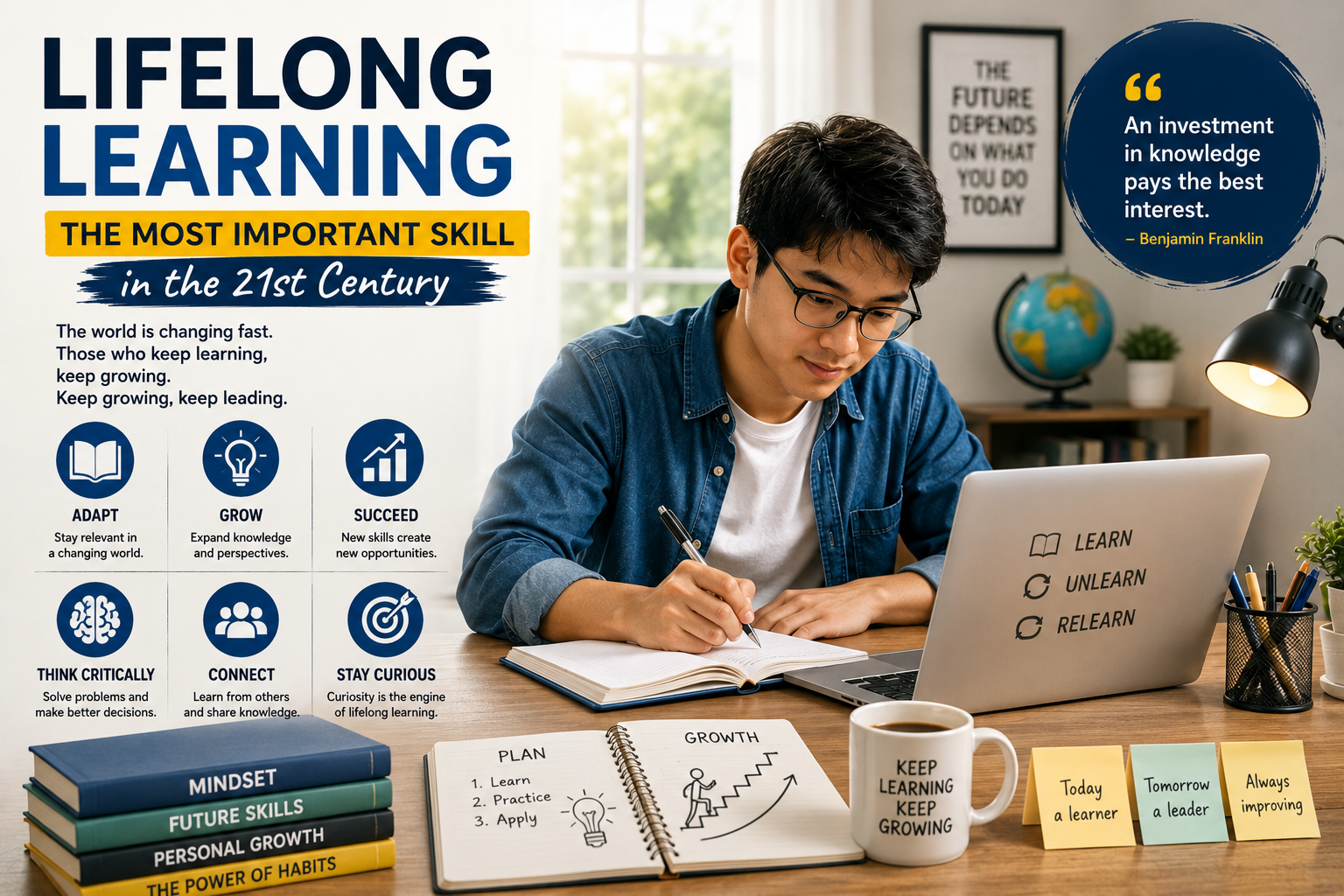
The world is changing faster than ever before. New technologies emerge every year, industries evolve, and careers that did not exist a decade ago are now among the most sought-after professions. In this rapidly changing environment, one ability has become more valuable than any single degree or technical skill: the willingness to keep learning throughout life.
Lifelong learning is no longer a luxury reserved for academics or professionals. It has become an essential mindset for anyone who wants to remain relevant, competitive, and adaptable in the 21st century.
Whether you are a student, entrepreneur, teacher, or employee, your greatest investment is not only in what you already know but also in your ability to continuously acquire new knowledge.
Why Lifelong Learning Matters More Than Ever
The Fourth Industrial Revolution and the rise of artificial intelligence have transformed nearly every industry. Automation now handles many repetitive tasks, while technology continues to reshape the way people work, communicate, and solve problems.
As a result, knowledge quickly becomes outdated.
A programming language that is popular today may be replaced in a few years. Marketing strategies evolve as consumer behavior changes. Even traditional professions now require digital skills that were unnecessary just a decade ago.
People who continue learning adapt more easily to these changes, while those who stop learning often struggle to keep pace.
Learning Is No Longer Limited to Schools
For many years, education was associated with classrooms, textbooks, and graduation ceremonies. Today, learning happens everywhere.
A person can watch lectures from leading universities, participate in online workshops, read digital books, join professional communities, or learn directly from industry experts—all without leaving home.
Technology has removed many barriers to education.
The challenge is no longer access to knowledge but the discipline to use it wisely.
Curiosity Is the Engine of Growth
Successful people share one common characteristic: they remain curious.
Curiosity encourages people to ask questions, seek better solutions, and explore new ideas.
Instead of saying,
“I already know enough,”
lifelong learners ask,
“What else can I learn today?”
This mindset opens doors to innovation, creativity, and personal growth.
The Workplace Rewards Continuous Learners
Modern employers value adaptability as much as technical expertise.
Organizations increasingly seek individuals who can:
• learn new technologies quickly;
• solve unfamiliar problems;
• communicate effectively;
• collaborate with diverse teams;
• embrace change with confidence.
In many industries, employees who continue developing their skills are more likely to receive promotions, leadership opportunities, and long-term career stability.
Learning has become a competitive advantage.
Technology Has Changed How We Learn
Digital technology has revolutionized education.
Today, learning can happen through:
• online courses;
• educational podcasts;
• webinars;
• digital libraries;
• virtual simulations;
• artificial intelligence learning assistants;
• interactive educational platforms.
Instead of replacing teachers, technology expands learning opportunities by making education more flexible and accessible.
The most successful learners combine technology with critical thinking rather than relying on technology alone.
Small Daily Habits Lead to Big Results
Many people believe they need hours of free time to learn something new.
In reality, consistency matters far more than intensity.
Reading just ten pages a day means finishing dozens of books every year.
Watching one educational video each morning can gradually build expertise.
Practicing a foreign language for fifteen minutes daily produces remarkable progress over time.
Small habits compound into significant achievements.
Failure Is Part of Learning
One of the greatest barriers to learning is the fear of making mistakes.
However, every expert was once a beginner.
Scientists conduct experiments that fail.
Entrepreneurs launch products that do not succeed.
Writers produce early drafts that require extensive revision.
Rather than avoiding failure, lifelong learners treat mistakes as valuable feedback.
Each setback becomes another lesson for future improvement.
Lifelong Learning Strengthens Soft Skills
Technical knowledge is important, but soft skills often determine long-term success.
Continuous learning helps develop:
• communication;
• leadership;
• emotional intelligence;
• creativity;
• critical thinking;
• teamwork;
• adaptability.
These skills remain valuable even as technology continues to evolve.
Artificial Intelligence Makes Learning Easier
Artificial intelligence has become a powerful learning companion.
Students can receive instant explanations.
Professionals can summarize research papers.
Entrepreneurs can brainstorm marketing ideas.
Teachers can prepare lesson plans more efficiently.
However, artificial intelligence should support learning—not replace independent thinking.
The ability to evaluate information critically remains an essential human skill.
Building a Lifelong Learning Habit
Developing a learning mindset does not require dramatic changes.
Simple habits can make a lasting difference:
• Read every day.
• Listen to educational podcasts.
• Take online courses regularly.
• Attend seminars and workshops.
• Learn one new skill every year.
• Reflect on your experiences.
• Share knowledge with others.
Learning becomes sustainable when it becomes part of everyday life.
Education Is an Investment, Not an Expense
Some people hesitate to invest in books, courses, or professional training.
Yet education consistently provides one of the highest long-term returns.
New knowledge can increase productivity.
New skills can create career opportunities.
New perspectives can inspire innovative ideas.
Unlike many material possessions, knowledge continues to grow in value over time.
The Future Belongs to Lifelong Learners
The future will not necessarily belong to the people with the highest grades or the longest résumés.
It will belong to those who continue learning, adapting, and improving.
Technology will continue to change.
Industries will continue to evolve.
New careers will emerge.
People who embrace lifelong learning will always be better prepared to navigate uncertainty and seize new opportunities.
Conclusion
Lifelong learning is no longer optional—it is one of the most valuable skills of the 21st century.
Every new skill you acquire, every book you read, every course you complete, and every lesson you learn contributes to your personal and professional growth.
Success is not defined by how much you know today.
It is defined by your willingness to keep learning tomorrow.
In a world that never stops changing, lifelong learning is the key to staying relevant, resilient, and ready for whatever comes next.
Frequently Asked Questions
What is lifelong learning?
Lifelong learning is the continuous process of acquiring knowledge and developing new skills throughout life, regardless of age or formal education.
Why is lifelong learning important?
It helps individuals adapt to technological changes, improve career opportunities, strengthen critical thinking, and remain competitive in an evolving job market.
How can I start lifelong learning?
Begin with small daily habits such as reading books, taking online courses, listening to educational podcasts, attending workshops, and practicing new skills consistently.
Is lifelong learning only for professionals?
No. Lifelong learning benefits everyone, including students, educators, entrepreneurs, parents, and retirees. Anyone can continue learning to improve their personal and professional life.