
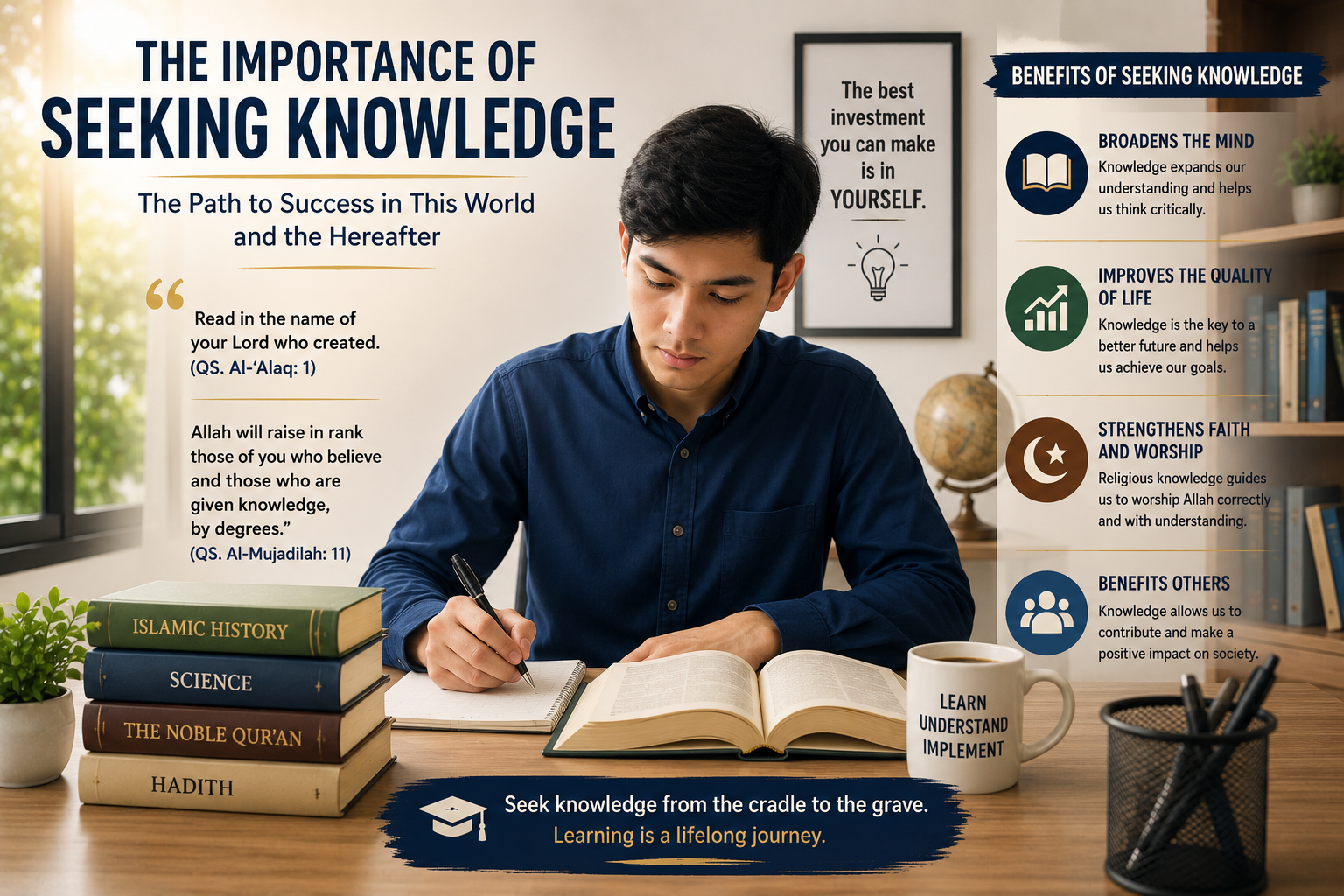
Seeking Knowledge as a Lifelong Journey
Knowledge is one of the greatest blessings bestowed upon humanity. It serves as a guiding light that helps people distinguish between right and wrong, truth and falsehood, and benefit and harm. In today’s rapidly changing world, knowledge has become an essential tool for personal growth, professional success, and social development.
Seeking knowledge is not limited to formal education or a specific stage of life. It is a lifelong responsibility that enables individuals to adapt to new challenges, improve their quality of life, and contribute positively to society. Those who continuously learn are better equipped to make informed decisions and achieve their goals.
The Significance of Knowledge in Islam
Islam places a high value on knowledge and education. The very first revelation received by Prophet Muhammad ﷺ was a command to read, emphasizing the importance of learning and intellectual development.
Allah says in the Holy Qur’an:
“Read in the name of your Lord who created.”
(Qur’an 96:1)
This verse highlights that the pursuit of knowledge is deeply rooted in Islamic teachings. It encourages believers to explore, learn, and reflect upon the signs of Allah in creation.
Furthermore, Allah elevates the status of those who possess knowledge:
“Allah will raise those who have believed among you and those who were given knowledge by degrees.”
(Qur’an 58:11)
This verse demonstrates that knowledge is a means of attaining honor and distinction both in this world and in the sight of Allah.
Benefits of Seeking Knowledge
- Broadens Understanding and Critical Thinking
Knowledge enables individuals to understand the world from a broader perspective. It develops critical thinking skills and helps people analyze situations objectively rather than relying on assumptions or misinformation.
In the digital age, where information is readily available, the ability to evaluate sources and distinguish facts from falsehoods is more important than ever. Knowledge empowers individuals to navigate information wisely and responsibly. - Improves Quality of Life
Education and knowledge play a crucial role in personal and professional success. They provide opportunities for better careers, financial stability, and social advancement.
Countries that invest in education often experience higher levels of economic growth and innovation. Likewise, individuals who continuously develop their skills are more likely to achieve success and make meaningful contributions to their communities. - Strengthens Faith and Worship
For Muslims, knowledge is essential for understanding and practicing religion correctly. Without proper knowledge, acts of worship may lack sincerity, accuracy, and understanding.
The Prophet Muhammad ﷺ said:
“When Allah wishes good for someone, He grants him understanding of the religion.”
(Sahih al-Bukhari and Sahih Muslim)
This hadith illustrates that religious knowledge is a sign of Allah’s favor and a pathway to spiritual growth. - Benefits Society
Knowledge is not meant to be kept for oneself. It should be shared and used for the benefit of others. Teachers educate students, doctors treat patients, engineers solve problems, and leaders make informed decisions based on their knowledge.
The more knowledge a person acquires, the greater their potential to contribute positively to society and create lasting impact.
Challenges of Learning in the Digital Era
Modern technology has made learning more accessible than ever before. Online courses, digital libraries, educational videos, and virtual classrooms provide countless opportunities for acquiring knowledge.
However, these advantages come with challenges. Social media distractions, entertainment overload, and information saturation can reduce focus and discourage meaningful learning. Many people spend hours consuming content without gaining valuable knowledge.
Therefore, self-discipline and intentional learning habits are necessary to ensure that technology becomes a tool for growth rather than a source of distraction.
How to Develop a Passion for Learning
To cultivate a lifelong love of learning, individuals can:
- Set sincere and meaningful goals for learning.
- Develop a daily reading habit.
- Surround themselves with knowledgeable and inspiring people.
- Attend seminars, workshops, and educational programs.
- Use technology wisely for educational purposes.
- Apply acquired knowledge in daily life.
Knowledge becomes more valuable when it is practiced and shared with others.
Conclusion
Seeking knowledge is both a responsibility and a privilege. It opens doors to success, strengthens faith, improves quality of life, and enables individuals to serve humanity more effectively. Throughout history, great civilizations have flourished because they valued education and intellectual development.
In a world that continues to evolve, the pursuit of knowledge remains one of the most powerful investments a person can make. Learning should not end with graduation or a specific achievement; rather, it should continue throughout life. As the famous saying goes, “Learning is a treasure that will follow its owner everywhere.”
By embracing knowledge and committing to lifelong learning, individuals can achieve success in this world while preparing for success in the Hereafter.