
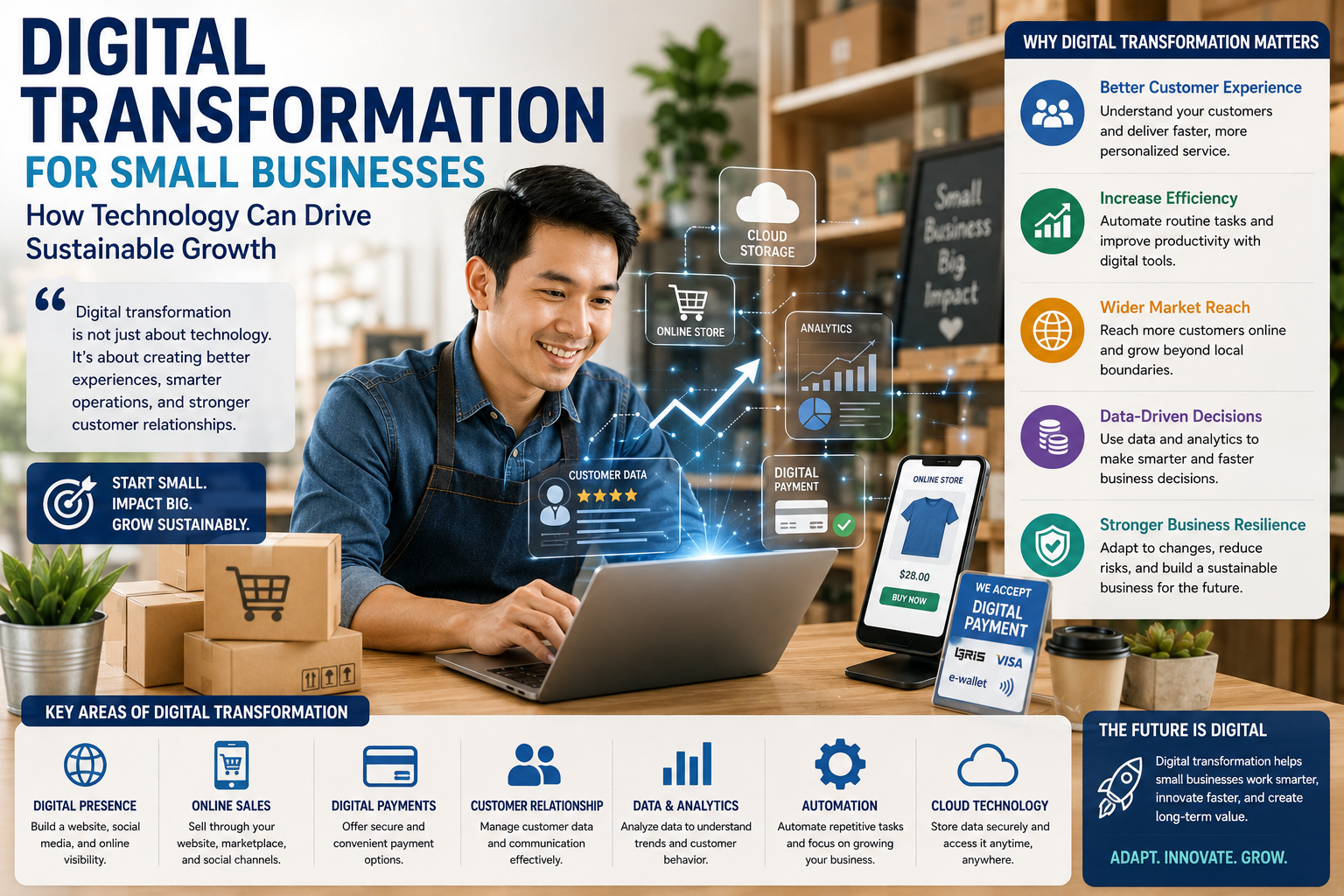
Technology is no longer something reserved for large corporations. Today, even small businesses can use digital tools to improve their operations, reach more customers, and compete in markets that were once difficult to access.
However, digital transformation is not simply about creating a social media account or buying new software. It is about changing the way a business works by using technology to make processes more efficient, customer experiences better, and decisions more informed.
For small businesses, this transformation does not have to happen all at once. Small and consistent improvements can create meaningful results over time.
What Is Digital Transformation?
Digital transformation is the process of using digital technology to improve business operations, customer experiences, and decision-making.
It can involve many different areas, including:
• digital marketing;
• online sales;
• cloud-based tools;
• digital payments;
• customer relationship management;
• data analytics;
• automation;
• artificial intelligence.
The goal is not simply to use more technology, but to use the right technology for the right business problem.
Why Does Digital Transformation Matter for Small Businesses?
Small businesses often operate with limited resources.
They may have fewer employees, smaller marketing budgets, and less time to manage administrative tasks.
Digital tools can help reduce some of these limitations.
For example, an online ordering system can reduce manual work, while digital accounting tools can make financial records easier to manage.
Technology can also help small businesses reach customers beyond their immediate geographic area.
Start with the Customer
A successful digital transformation should begin with customer needs.
Before adopting a new technology, business owners should ask:
• What problems do our customers experience?
• Which part of the buying process is difficult?
• How can we respond faster?
• What information do customers need?
• How can we make purchasing easier?
These questions help businesses avoid adopting technology simply because it is popular.
Build a Strong Digital Presence
One of the simplest steps toward digital transformation is establishing a professional online presence.
Depending on the business, this may include:
• a website;
• Google Business Profile;
• social media accounts;
• online marketplaces;
• messaging platforms.
A strong digital presence allows potential customers to discover the business, learn about its products, and contact the company more easily.
Use Digital Payments
Digital payment systems can make transactions faster and more convenient.
Customers increasingly expect businesses to provide multiple payment options.
For small businesses, digital payments can also make transaction records easier to organize and review.
However, security should always be considered when implementing digital payment systems.
Use Data to Make Better Decisions
Small businesses generate data every day.
Sales transactions, website visits, customer inquiries, social media engagement, and product reviews can all provide useful information.
Instead of relying entirely on intuition, business owners can analyze these data points to identify trends.
For example, a business may discover that one product consistently performs better on weekends or that certain promotional campaigns generate more inquiries than others.
Small insights can lead to better decisions.
Automate Repetitive Tasks
Many business activities are repetitive.
Sending routine messages, organizing appointments, creating invoices, managing inventory, and generating reports can consume valuable time.
Automation can help reduce this workload.
The time saved can then be used for activities that require human judgment, creativity, and customer interaction.
Cloud Technology for Small Businesses
Cloud-based tools allow businesses to store and access information from different devices and locations.
Teams can collaborate on documents, manage projects, store files, and access business applications without depending entirely on a single computer.
This can be particularly useful for businesses with employees working remotely or across different locations.
Artificial Intelligence as a Business Assistant
Artificial Intelligence (AI) is becoming increasingly accessible to small businesses.
AI tools can assist with:
• generating content ideas;
• analyzing customer feedback;
• summarizing information;
• creating marketing drafts;
• organizing data;
• supporting customer service.
However, AI should be treated as a business assistant, not a replacement for human judgment.
Business owners still need to review information, protect customer data, and make final decisions.
Digital Transformation Does Not Mean Expensive Technology
One common misconception is that digital transformation requires a large investment.
In reality, businesses can start with simple solutions.
For example:
Stage 1: Create a professional online presence.
Stage 2: Introduce digital payments.
Stage 3: Organize customer data.
Stage 4: Move important documents to cloud-based systems.
Stage 5: Introduce automation.
Stage 6: Use analytics and AI to support decision-making.
This gradual approach allows businesses to learn while minimizing unnecessary costs.
Common Mistakes to Avoid
Digital transformation can fail when businesses focus too much on technology and too little on their actual needs.
Common mistakes include:
• adopting too many tools at once;
• ignoring employee training;
• failing to protect customer data;
• choosing technology without a clear purpose;
• focusing on trends rather than business outcomes;
• expecting immediate results.
Technology should solve problems, not create additional complexity.
People Still Matter
Even in a highly digital business, people remain important.
Customers appreciate human communication, empathy, creativity, and problem-solving.
Employees also need opportunities to learn new skills as technology changes.
The most successful digital transformation combines technology with human capability.
Creating a Sustainable Digital Strategy
A sustainable digital strategy should be realistic and measurable.
Business owners can start by identifying one or two important problems.
Then choose a digital solution, test it, measure the results, and improve the process.
This approach creates a culture of continuous improvement rather than a one-time technology project.
The Future of Small Businesses
The digital economy will continue to evolve.
New technologies will emerge, customer expectations will change, and competition will become increasingly global.
Small businesses that are willing to learn and adapt will have more opportunities to remain competitive.
Digital transformation is therefore not simply about adopting technology today. It is about building the ability to adapt to tomorrow.
Conclusion
Digital transformation gives small businesses an opportunity to work smarter, reach wider markets, understand customers better, and build more efficient operations.
The process does not need to begin with expensive technology.
It can start with a simple website, digital payment, organized customer data, cloud-based tools, or better use of analytics.
What matters most is having a clear purpose and a willingness to keep learning.
Technology may provide the tools, but people determine how those tools create value.
Frequently Asked Questions
What is digital transformation for small businesses?
It is the process of using digital technology to improve business operations, customer experiences, marketing, and decision-making.
Does digital transformation require a large investment?
No. Small businesses can begin with affordable or even free digital tools and gradually adopt more advanced solutions as their needs grow.
What technology should a small business adopt first?
There is no universal answer. Businesses should start with technology that solves their most important problem, such as improving communication, payments, marketing, record keeping, or customer management.
Can AI help small businesses?
Yes. AI can assist with content creation, data analysis, customer support, research, and many other tasks, provided that businesses use it responsibly and review its output.