
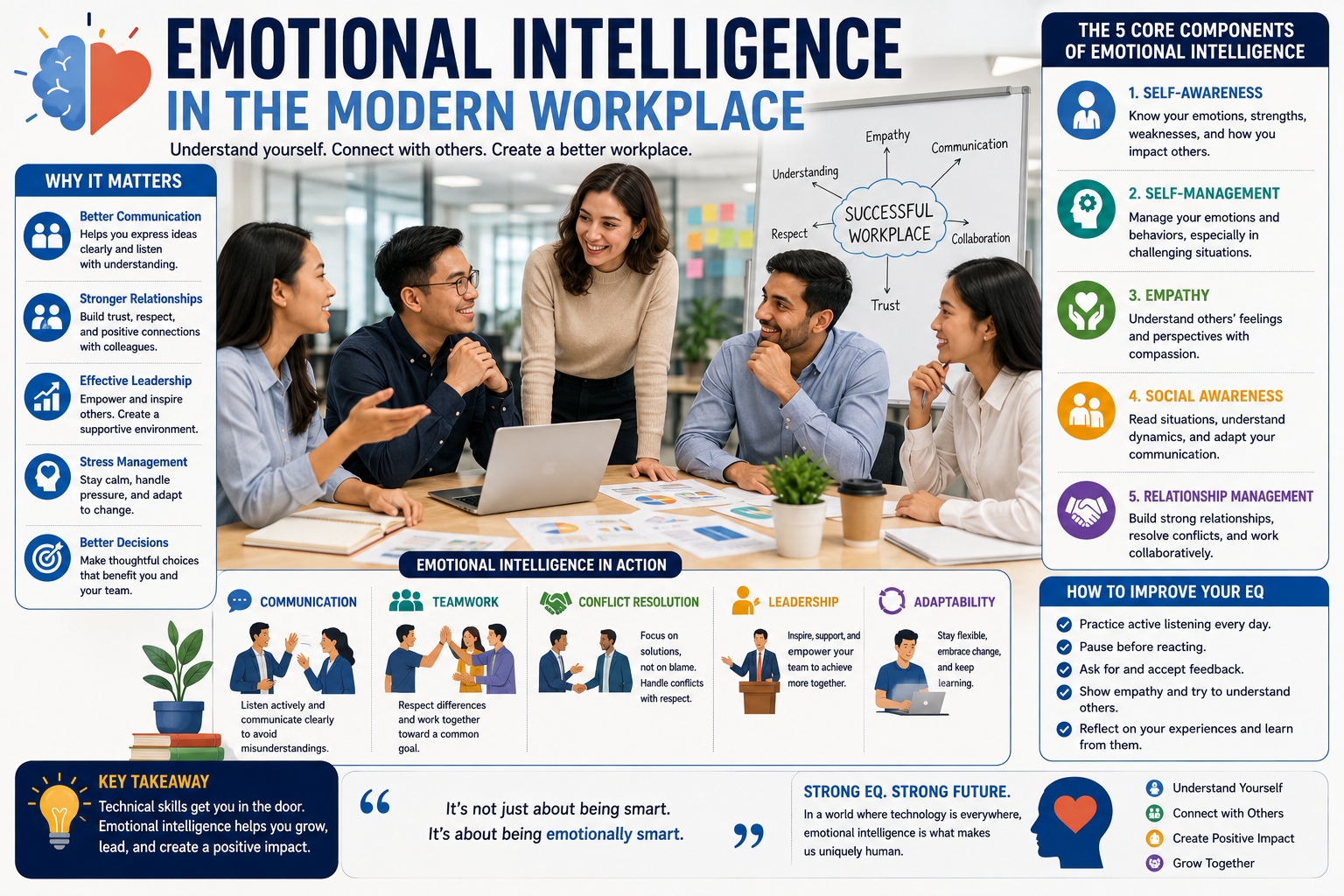
Technical knowledge can help someone get a job, but technical skills alone do not always determine long-term success.
In the modern workplace, people are expected to communicate effectively, work with different personalities, manage pressure, solve conflicts, and adapt to changing situations. These abilities are closely related to emotional intelligence.
Emotional intelligence helps people understand their own emotions, recognize the emotions of others, and respond to situations in a thoughtful and constructive way.
As workplaces become increasingly collaborative and digital, emotional intelligence is becoming an increasingly valuable skill for employees, leaders, educators, entrepreneurs, and professionals.
What Is Emotional Intelligence?
Emotional intelligence, often abbreviated as EQ, is the ability to recognize, understand, manage, and respond appropriately to emotions.
It involves both self-awareness and awareness of other people.
Someone with strong emotional intelligence does not necessarily avoid negative emotions. Instead, they learn how to understand those emotions and manage their responses effectively.
For example, feeling frustrated during a difficult project is normal. Emotional intelligence helps a person recognize that frustration without allowing it to lead to an inappropriate reaction.
Why Is Emotional Intelligence Important?
Modern workplaces involve constant interaction.
Employees communicate through meetings, emails, messaging platforms, video conferences, and face-to-face conversations.
Misunderstandings can happen easily.
Emotional intelligence helps people communicate more thoughtfully and build healthier professional relationships.
It can also contribute to:
• better teamwork;
• stronger communication;
• effective leadership;
• conflict management;
• stress management;
• better decision-making;
• stronger professional relationships.
The Five Important Components of Emotional Intelligence
Emotional intelligence can be understood through several interconnected abilities.
- Self-Awareness
Self-awareness means understanding your own emotions, strengths, weaknesses, values, and reactions.
A self-aware employee can recognize when they are becoming frustrated, anxious, or overwhelmed.
Instead of immediately reacting, they can pause and consider the best response. - Self-Management
Understanding emotions is only the beginning.
The next step is learning how to manage them.
Self-management helps people remain professional when facing pressure, criticism, disagreement, or unexpected problems.
It does not mean suppressing emotions.
It means responding to emotions responsibly. - Empathy
Empathy is the ability to understand or recognize what another person may be experiencing.
For example, a manager may notice that an employee who normally participates actively has suddenly become quiet.
Instead of immediately assuming that the employee is not interested, the manager can ask questions and listen.
Empathy creates space for understanding. - Social Awareness
Social awareness involves understanding the emotions, dynamics, and expectations within a group.
It helps people recognize when communication needs to change depending on the situation.
The way someone communicates with a close colleague may be different from how they communicate during a formal meeting with clients.
Understanding context is an important part of effective communication. - Relationship Management
The final component involves building and maintaining healthy relationships.
Relationship management includes:
• active listening;
• constructive feedback;
• conflict resolution;
• collaboration;
• appreciation;
• clear communication.
Strong relationships can improve teamwork and create a healthier working environment.
Emotional Intelligence and Leadership
Technical expertise does not automatically make someone a good leader.
Effective leaders need to understand people.
A leader with emotional intelligence can listen to employees, provide constructive feedback, manage disagreements, and recognize the contributions of team members.
Good leadership is not simply about giving instructions.
It is also about creating an environment where people feel respected, supported, and motivated to contribute.
Emotional Intelligence and Teamwork
Teams are made up of people with different backgrounds, personalities, communication styles, and expectations.
Differences can create conflict, but they can also create opportunities for innovation.
Emotional intelligence helps team members handle differences without allowing them to damage collaboration.
For example, when two team members disagree about a project, emotional intelligence encourages them to focus on the problem rather than attacking each other personally.
Emotional Intelligence in Digital Communication
Digital communication has changed the way people work.
Emails and text messages do not always communicate tone clearly.
A short message may unintentionally sound rude or dismissive.
Emotional intelligence can help people think before sending a message.
Before pressing the send button, ask:
• Is the message clear?
• Could it be misunderstood?
• Is the tone appropriate?
• Does the recipient need additional context?
• Would a direct conversation be better?
These simple questions can prevent unnecessary misunderstandings.
Emotional Intelligence and Conflict Resolution
Conflict is not always negative.
Healthy disagreement can lead to better ideas and decisions.
The problem occurs when disagreement becomes personal.
Emotional intelligence helps people separate the person from the problem.
Instead of saying:
“You always make mistakes.”
A more constructive approach would be:
“Let’s look at what happened and find a way to improve the process.”
This approach focuses on solutions rather than blame.
Emotional Intelligence and Career Development
Career development is not only about collecting certificates and technical qualifications.
Employers often value professionals who can:
• communicate clearly;
• cooperate with colleagues;
• handle feedback;
• adapt to change;
• solve problems;
• manage difficult situations.
Emotional intelligence supports many of these abilities.
As a result, developing EQ can complement technical skills and professional qualifications.
How to Improve Emotional Intelligence
Emotional intelligence can be developed through regular practice.
Practice Active Listening
Do not listen only to prepare your response.
Listen to understand.
Pay attention to words, tone, and context.
Pause Before Reacting
When you feel angry or frustrated, give yourself a moment before responding.
A short pause can prevent an emotional reaction from becoming a professional problem.
Ask for Feedback
Other people may notice behaviors that you do not recognize in yourself.
Constructive feedback can help identify areas for improvement.
Practice Empathy
Before judging someone, try to understand their situation.
Ask yourself:
“What might this person be experiencing?”
This simple question can change the way you respond.
Reflect Regularly
At the end of the day or after an important interaction, reflect on what happened.
Ask:
• What did I do well?
• What could I have handled differently?
• How did my words affect others?
• What can I learn from the situation?
Reflection turns everyday experiences into opportunities for growth.
Emotional Intelligence and Artificial Intelligence
As Artificial Intelligence continues to automate many technical and routine tasks, human capabilities become increasingly important.
AI can process information quickly, generate content, analyze data, and support decision-making.
However, human interaction still requires empathy, ethical judgment, trust, and emotional understanding.
This does not mean emotional intelligence will replace technical skills.
Instead, the future of work will increasingly require a combination of:
Technical Skills + Digital Skills + Emotional Intelligence
Professionals who can combine these abilities may be better prepared for changing workplace demands.
Emotional Intelligence for Students
Emotional intelligence should not only be developed after entering the workplace.
Students can begin practicing it early.
Schools and universities can encourage:
• teamwork;
• communication;
• reflection;
• peer feedback;
• collaborative projects;
• conflict resolution;
• leadership activities.
These experiences help students develop interpersonal skills alongside academic knowledge.
Emotional Intelligence and Lifelong Learning
Learning does not end when someone graduates.
As people move through different stages of life and career, they encounter new challenges and relationships.
Emotional intelligence supports lifelong learning because it encourages people to accept feedback, recognize weaknesses, adapt to change, and remain open to different perspectives.
The Future of Emotional Intelligence
Technology will continue to transform the workplace.
Some jobs will disappear, new jobs will emerge, and many existing roles will change.
In this environment, adaptability and human connection will remain valuable.
Emotional intelligence is therefore not simply a “soft skill.”
It is an important human capability that can support communication, leadership, collaboration, and professional growth.
Conclusion
Emotional intelligence plays an important role in modern professional life.
It helps people understand themselves, communicate with others, manage conflict, build relationships, and respond to challenging situations more effectively.
Technical expertise remains essential, but professional success increasingly depends on how people use their knowledge while working with others.
By developing self-awareness, empathy, communication, and relationship management, individuals can become more effective professionals and better leaders.
The future of work will not only belong to people who know more, but also to people who understand themselves and know how to work well with others.
Frequently Asked Questions
What is emotional intelligence?
Emotional intelligence is the ability to recognize, understand, manage, and respond appropriately to emotions in ourselves and others.
Why is emotional intelligence important at work?
It supports communication, teamwork, leadership, conflict resolution, adaptability, and healthy professional relationships.
Can emotional intelligence be learned?
Yes. Emotional intelligence can be developed through active listening, self-reflection, empathy, feedback, and deliberate practice.
Is emotional intelligence more important than technical skills?
Neither replaces the other. Technical skills are important for performing a job, while emotional intelligence helps people communicate, collaborate, lead, and adapt effectively.
How can students develop emotional intelligence?
Students can develop it through teamwork, collaborative projects, leadership activities, reflection, communication exercises, and learning to handle disagreements constructively.