
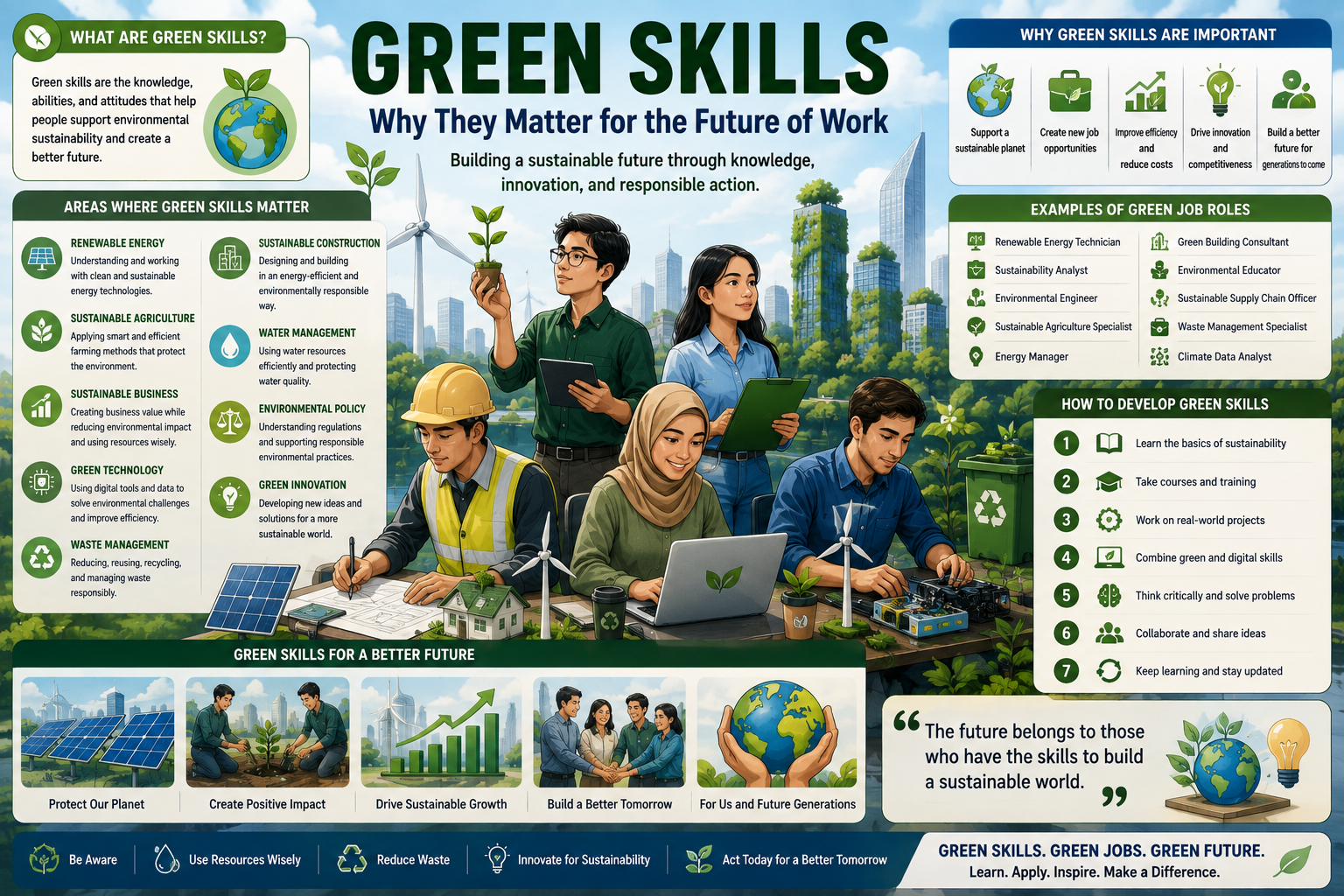
The world of work is changing rapidly.
Technology is transforming industries, while environmental challenges are influencing how businesses operate. Companies are increasingly paying attention to energy efficiency, sustainable production, responsible resource management, waste reduction, and environmental impact.
These changes are creating demand for a new category of competencies known as green skills.
Green skills are not limited to environmental scientists or sustainability professionals. They can become valuable across many occupations, including technology, manufacturing, agriculture, education, business, construction, transportation, and finance.
As economies move toward more sustainable practices, understanding green skills can help students, workers, entrepreneurs, and organizations prepare for the future.
What Are Green Skills?
Green skills are the knowledge, abilities, attitudes, and competencies that help people support environmentally sustainable activities and practices.
They can include technical abilities, such as:
• renewable energy technology;
• sustainable agriculture;
• environmental monitoring;
• energy management;
• waste management;
• sustainable construction.
But green skills can also include broader abilities such as:
• resource efficiency;
• environmental awareness;
• sustainable decision-making;
• systems thinking;
• innovation;
• problem-solving.
Therefore, green skills are relevant to many different professions.
Why Are Green Skills Becoming Important?
Environmental challenges are affecting businesses and communities around the world.
Organizations are increasingly considering questions such as:
• How can energy consumption be reduced?
• How can waste be minimized?
• How can resources be used more efficiently?
• How can products be designed more sustainably?
• How can environmental risks be managed?
These questions require people with appropriate knowledge and skills.
As a result, sustainability is becoming increasingly connected with workforce development.
Green Skills Are Not Only for Environmental Jobs
One common misunderstanding is that green skills are only useful for people working in environmental fields.
That is not the case.
A software developer can work on applications that help organizations monitor energy consumption.
An accountant can contribute to sustainability reporting.
A marketing professional can communicate sustainable products responsibly.
A factory worker can learn energy-efficient production practices.
A teacher can introduce sustainability concepts to students.
Green skills can therefore be integrated into many existing professions.
Technical Green Skills
Some occupations require highly specialized technical knowledge.
Examples include:
Renewable Energy
Understanding solar, wind, and other renewable energy technologies.
Sustainable Agriculture
Using agricultural practices that improve resource efficiency and environmental sustainability.
Environmental Engineering
Designing systems that address environmental challenges.
Energy Management
Monitoring and improving energy consumption.
Waste Management
Developing systems for reducing, reusing, recycling, and responsibly managing waste.
These skills may require specialized education and training.
Green Skills in Business
Businesses play an important role in the transition toward more sustainable economic activity.
Companies may need employees who understand:
• sustainable supply chains;
• energy efficiency;
• resource management;
• environmental compliance;
• sustainable product development;
• responsible procurement.
For businesses, green skills can contribute not only to environmental goals but also to efficiency and innovation.
Green Skills and Digital Technology
Digital technology can support sustainability in many ways.
For example, organizations can use digital systems to monitor:
• energy consumption;
• transportation;
• inventory;
• production;
• waste;
• resource utilization.
Data can help businesses identify inefficiencies.
Artificial Intelligence and data analytics may also support more efficient decision-making in areas such as energy management, logistics, and resource planning.
This creates an interesting combination:
Digital Skills + Green Skills
Professionals who understand both areas can potentially contribute to new types of solutions.
Green Skills for the Technology Industry
Technology companies may appear unrelated to environmental issues, but the technology sector also faces sustainability challenges.
Areas of interest include:
• energy-efficient computing;
• sustainable data centers;
• electronic waste;
• hardware lifecycle management;
• efficient software systems;
• responsible resource use.
Technology professionals can therefore benefit from understanding the environmental impact of digital infrastructure.
Green Skills in Agriculture
Agriculture depends heavily on natural resources.
Green skills can support farmers and agricultural businesses in areas such as:
• water efficiency;
• soil management;
• sustainable farming;
• responsible fertilizer use;
• waste reduction;
• renewable energy;
• climate-resilient practices.
Technology can also support agriculture through sensors, data analytics, automation, and precision farming.
Green Skills in Manufacturing
Manufacturing processes often involve significant amounts of energy and raw materials.
Green skills can help organizations improve:
• energy efficiency;
• material efficiency;
• waste reduction;
• production processes;
• product lifecycle management;
• recycling.
Employees who understand both manufacturing processes and sustainability can help organizations identify practical improvements.
Green Skills in Construction
The construction industry is another area where sustainability can become increasingly important.
Professionals may need knowledge about:
• energy-efficient buildings;
• sustainable materials;
• waste reduction;
• water efficiency;
• building performance;
• environmentally responsible construction practices.
This means future construction professionals may need a combination of traditional technical knowledge and sustainability competencies.
Green Skills for Students
Students can begin developing green skills before entering the workforce.
They do not necessarily need to study environmental science.
They can start by learning:
• basic environmental concepts;
• sustainable resource use;
• problem-solving;
• systems thinking;
• digital tools;
• data analysis;
• responsible consumption.
School projects can also connect sustainability with mathematics, science, technology, business, and social studies.
Green Skills and Education
Education has an important role in preparing future workers.
Schools, universities, and training institutions can integrate sustainability into existing subjects.
For example:
Computer Science + Energy Efficiency
Business + Sustainable Supply Chains
Agriculture + Resource Management
Design + Sustainable Materials
Engineering + Renewable Energy
This interdisciplinary approach can make green skills more relevant to real-world careers.
The Importance of Systems Thinking
One valuable green skill is systems thinking.
Environmental problems are rarely isolated.
For example, producing a product may involve:
Raw Materials → Manufacturing → Transportation → Retail → Consumer → Waste
Changing one part of the system can affect another.
Systems thinking helps people understand these connections rather than looking at individual problems separately.
Problem-Solving and Green Innovation
Sustainability often requires new solutions.
Businesses may need to find ways to:
• reduce packaging;
• reduce energy use;
• redesign products;
• improve logistics;
• reuse materials;
• reduce waste.
This requires creativity and problem-solving.
Green innovation is therefore not only about environmental awareness.
It is also about finding practical solutions.
Green Skills and Entrepreneurship
Entrepreneurs can use sustainability as an opportunity to develop new products and services.
Examples include:
• reusable products;
• sustainable packaging;
• energy-saving services;
• recycling businesses;
• environmentally responsible tourism;
• sustainable agriculture;
• repair and refurbishment services.
However, sustainability claims should be supported by real practices.
Businesses should avoid making environmental claims that are misleading or unsupported.
Green Skills for Small Businesses
Small businesses can also benefit from green skills.
A small business may begin with simple improvements:
• reducing electricity consumption;
• minimizing paper use;
• reducing packaging;
• separating waste;
• optimizing delivery routes;
• choosing durable equipment;
• reducing unnecessary resource consumption.
These actions can potentially support both environmental goals and operational efficiency.
Green Skills and the Circular Economy
Another important concept is the circular economy.
A traditional model often follows:
Take → Make → Use → Dispose
A circular approach seeks to keep products and materials in use for as long as possible.
It may emphasize:
Reduce → Reuse → Repair → Refurbish → Recycle
This concept creates demand for new knowledge and skills across product design, manufacturing, logistics, retail, and waste management.
Green Skills and Career Development
Workers can strengthen their career prospects by combining existing expertise with sustainability knowledge.
For example:
Marketing + Sustainability
IT + Energy Management
Finance + Sustainability Reporting
Agriculture + Digital Technology
Design + Sustainable Materials
This approach is often more practical than starting an entirely new career.
The goal is to add relevant competencies to an existing professional foundation.
How to Develop Green Skills
There are several ways to begin.
- Learn the Basics
Understand concepts such as sustainability, circular economy, renewable energy, and resource efficiency. - Take Short Courses
Online courses and professional training can provide specialized knowledge. - Work on Projects
Practical projects help transform knowledge into usable skills. - Analyze Real Problems
Study how businesses, schools, or communities use energy and resources. - Combine Green and Digital Skills
Learn how technology can support sustainability. - Keep Learning
Sustainability practices and technologies continue to evolve.
Green Skills and the Future of Work
The future of work will likely require professionals who can adapt to technological and environmental changes simultaneously.
A worker may need to understand:
Digital Transformation
• Sustainability
• Human Skills
This combination can become increasingly valuable across industries.
The future worker is not necessarily someone who belongs to one narrow category.
Instead, adaptability and interdisciplinary knowledge may become important advantages.
Challenges in Developing Green Skills
The transition is not always easy.
Some challenges include:
Skills Gaps
Workers may not have access to relevant training.
Rapid Technological Change
New technologies can quickly change job requirements.
Limited Awareness
Some organizations may not yet understand which green skills they need.
Training Costs
Specialized education can require significant investment.
Unequal Access
Not everyone has the same access to technology, education, or professional development.
Addressing these challenges requires cooperation between education institutions, businesses, governments, and communities.
Green Skills and Lifelong Learning
Green skills are not something people learn once and then stop developing.
Environmental technology, regulations, business practices, and consumer expectations can change over time.
Therefore, professionals need a mindset of continuous learning.
Someone who starts learning sustainability today may need to update that knowledge several years from now.
This makes lifelong learning an important part of green career development.
A Simple Green Skills Roadmap
For beginners, the journey can be simple:
Step 1: Learn sustainability basics.
Step 2: Identify environmental issues in your field.
Step 3: Learn relevant technical skills.
Step 4: Combine them with digital skills.
Step 5: Apply the knowledge to a practical project.
Step 6: Build a portfolio.
Step 7: Continue learning.
This approach makes green skills more practical and career-oriented.
The Role of Employers
Organizations also have a responsibility to develop their workforce.
Employers can provide:
• sustainability training;
• energy-efficiency programs;
• environmental awareness workshops;
• practical improvement projects;
• professional development opportunities.
Instead of expecting employees to already possess every required skill, organizations can invest in learning.
The Future of Green Skills
As businesses and societies continue to address environmental challenges, green skills may become increasingly integrated into mainstream professional development.
Future careers may not simply be divided into:
“green jobs” and “non-green jobs.”
Instead, sustainability competencies may become part of many occupations.
A designer may need sustainable design knowledge.
A software engineer may need to understand energy-efficient computing.
A business manager may need sustainability strategy skills.
A teacher may need to introduce environmental literacy.
Conclusion
Green skills are becoming increasingly relevant as technology, business, education, and environmental challenges continue to evolve.
They are not limited to environmental specialists.
People working in technology, agriculture, education, manufacturing, finance, marketing, construction, and many other fields can benefit from understanding sustainability.
The strongest approach may be to combine existing professional expertise with green competencies and digital skills.
The future of work will require people who can not only use technology effectively, but also understand how to create value while using resources responsibly.
Developing green skills today can therefore be a meaningful investment in both career development and a more sustainable future.
Frequently Asked Questions
What are green skills?
Green skills are knowledge, abilities, and competencies that help people support environmentally sustainable activities, processes, products, and decisions.
Are green skills only for environmental jobs?
No. Green skills can be useful across technology, business, agriculture, education, manufacturing, construction, finance, and many other fields.
Why are green skills important for the future of work?
Businesses and organizations are increasingly addressing resource efficiency, sustainability, environmental risks, and changing market expectations. This creates demand for relevant knowledge and competencies.
How can students develop green skills?
Students can learn sustainability concepts, participate in environmental projects, develop problem-solving abilities, use digital tools, and connect sustainability with their chosen fields.
Can green skills help entrepreneurs?
Yes. Green skills can help entrepreneurs identify opportunities involving resource efficiency, sustainable products, circular business models, renewable energy, recycling, and other areas.